Showing posts with label Indian Navy. Show all posts

11 February 2017

International Fleet Review 2016, Vizag 6.2.2016

The only previous International Fleet Review in India was conducted in February 2001, off Mumbai. This earned the country widespread appreciation and goodwill. On 06th February 2016, the President of India, is scheduled to review the fleet of participating Indian and foreign warships off Vishakhapatnam. The International Fleet Review 2016 logo depicts the 3 operating dimensions of the Navy, with a ship, submarine and an aircraft, and also letters I-F-R form an integral part of the logo. The Dolphin has been chosen as the mascot, depicting friendship across oceans, and the theme is ‘United through Oceans’.
Normally called the ‘International Fleet Review’ (IFR), this event then provides the host nation an occasion to display its own naval prowess, and the bridges of friendship and trust it has built with other maritime nations. Owing to the many military-diplomatic benefits it accrues to the nation, the Indian Navy is conducting an International Fleet Review 2016, at Vishakhapatnam.

28 January 2017

‘Project Rukmani’ of ISRO 14.2.2015


Indian Navy’s tryst with a dedicated Defence communication satellite began on 30th August 2013 with the successful launch of GSAT-7 bythe Indian Space Research Organisation (ISRO) from French Guianaunder the project christened “Project Rukmani”. With this landmark event, Indian Navy joined the elite group of Navies that possess the capability to conduct operations using dedicated communication satellites.

12 January 2017

INS Vikramaditya 4.12.2013

INS Vikramaditya (Vikramāditya meaning "Brave as the Sun") is a modified Kiev-class aircraft carrier which entered into service with the Indian Navy in 2013. She has been renamed in honour of Vikramaditya, a legendary emperor of Ujjain, India.
Originally built as Baku and commissioned in 1987, the carrier served with the Soviet Navy and later with the Russian Navy (as Admiral Gorshkov) before being decommissioned in 1996 as she was too expensive to operate on a post-Cold War budget. The carrier was purchased by India on 20 January 2004 after years of negotiations at a final price of $2.35 billion. The ship successfully completed her sea trials in July 2013 and aviation trials in September 2013.
She was commissioned on 16 November 2013 at a ceremony held at Severodvinsk, Russia.  

29 November 2016

President’s Fleet Review at Mumbai 19.12.2011

Naval Fleet Reviews are ceremonial occasions traditionally held by Navies the world over to showcase their prowess. The Review is a grand and formal occasion when all operational naval vessels and aircrafts are spruced up in a spirit of loyalty and allegiance to the nation and the Supreme Commander. The President’s Fleet Review is a symbolic display of a nation’s maritime capabilities and prowess. It is meant to convey to the Supreme Commander and to the nation that the country’s maritime forces are fighting fit and ready to meet any challenge. 
In India too, it is a time honoured tradition that the President of India, as the Supreme Commander of the Armed Forces, reviews the Naval Fleet once during her/his tenure. Nine such reviews have taken place since independence.
For the reviews, participating units, which include warships, submarines, auxiliary vessels, Coast Guard ships, etc. are anchored in formation in precise columns. The President of India embarks on a naval vessel designated as the ‘Presidential Yacht’ and reviews all the ships by cruising past them. Simultaneously, naval aircrafts of the Naval Air Arm fly past in a salute overhead.

05 September 2016

The BrahMos is a short-range ramjet supersonic cruise missile 22.12.2008

The BrahMos is a short-range ramjet supersonic cruise missile that can be launched from submarines, ships, aircraft or land. It is a joint venture between the Russian Federation's NPO Mashinostroeyenia and India's Defence Research and Development Organisation (DRDO) who have together formed BrahMos Aerospace. It is based on the Russian P-800 Oniks cruise missile and other similar sea-skimming Russian cruise missile technology. The name BrahMos is a portmanteau formed from the names of two rivers, the Brahmaputra of India and the Moskva of Russia.
It is the world's fastest anti-ship cruise missile in operation. The missile travels at speeds of Mach 2.8 to 3.0. The land-launched and ship-launched versions are already in service, with the air and submarine-launched versions currently in the testing phase. An air-launched variant of BrahMos is planned which came out in 2012. A hypersonic version of the missile, BrahMos-II, is also presently under development with speed of Mach 7 to boost aerial fast strike capability. It is expected to be ready for testing by 2017.
Though India had wanted the BrahMos to be based on a mid range cruise missile like P-700 Granit, Russia opted for the shorter range sister of the missile, P-800 Oniks, in order to comply with Missile Technology Control Regime restrictions, to which Russia (also India w.e.f. 2016) is a signatory. Its propulsion is based on the Russian missile, and missile guidance has been developed by BrahMos Aerospace. The missile is expected to reach a total order worth US$13 billion.

15 June 2016

2006 Indian Naval Fleet Review at Vizag 1.2.2006


A Naval Fleet Review is a long-standing tradition followed by Navies all over the world. It is a grand occasion when every operational ship is spruced up, proudly displaying its crest and its company in spirit of loyalty and allegiance to the country. The idea of a Review was perhaps conceived as a show of naval might or an inspection of readiness for battle at sea. It still has the same connotation, but assembling the warships for peaceful purposes is now the norm of modern times. Later reviews were used as a celebratory demonstration for victories in battle or for other special occasions.
The First Fleet review in the East coast was held in 2006 and was reviewed byPresident APJ Abdul Kalam. Incidentally this was the second International Fleet Review being held in India and the first in East Coast. The last international Fleet review was held in Mumbai in 2001 reviewed by then President Dr K. R. Narayanan.

11 June 2016

Builder's Navy 4.12.2005

The existence of an ancient sea-faring, shipbuilding and repair tradition in India can be traced back to around 2300 BC. It is believed that the first tidal dock of the world was built at Lothal during the Harappan Civilisation, near the present day Mangrolharbour on the Gujarat coast. The Rig Vedas mentions Varuna, who has knowledge of the ocean routes. It describes naval expeditions, which used hundred-oared ships to subdue other kingdoms. The Atharva Veda also mentions boats, which were spacious, well constructed and comfortable.

The commemorative postage stamp on the Builder’s Navy depicts a Leander class Frigate (Udaygiri), a Kora class ship and a Delhi class ship.

Even in the pre independence India, Indian shipbuilders continued to hold their own well into the nineteenth century. Many Indian built ships were inducted into the Royal Navy, i.e. HMS Hindostan in 1795, the frigate Cornwallis in 1800, HMS Camel in 1806 and HMS Ceylon in 1808. Another landmark was the construction of the Bombay Dock, which was completed in 1735 and is in use even today in the Naval Dockyard at Fort Bombay.

The Navy of independent India made a modest beginning with half a dozen destroyers and frigates, a few mine sweepers along with a corvette and a survey vessel inherited from the Royal Indian Navy. The creation of a Corps of Naval Constructors in 1954, setting up of a Central Design Office (CDO) in 1964 and the decision to construct Leander class frigates under license at Mazagaon Dock Ltd. in early sixties marked the early steps of modern warship building in the country. The Directorate of Naval Ship Design, established in 1970, followed by Directorates of Ship Production and Submarine Design has metamorphosed into the controllerate of Warships Production and Acquisitions at Naval Headquarters. The Indian Navy’s resolute pursuit of indigenous design efforts, combined with the relentless endeavours of our shipyards in construction of warships and submarines have laid the foundation of what is proudly termed a “Builder’s Navy”.

From a modest beginning of designing small vessels such as Ocean Going Tugs, Landing Craft Utility, Seaward Defence Boats and Survey Crafts, the naval designers graduated to designing of Landing Ship Tank, Sandhayak class Survey Vessels and Training ship (INS Tir) productionised by the three defence PSUs, Mazagaon Docks Ltd., Mumbai, Garden Reach Shipbuilders and Engineers, Kolkata and Goa Shipyard. In the mid eighties, designing of missile corvettes, Delhi class Missile Destroyers and Brahmaputra class Missile frigates posed many challenges, which were all successfully overcome. The production of two German type 209 submarines in MDL under license between 1984 and 1994 was another hallmark achievement. The Navy is presently engaged in the design and production of the modern Shivalik class multi-purpose Frigates incorporating latest design concepts and stealth features.

Along with indigenous ship building efforts, development of indigenous machinery, equipment, systems, weapons and materials has also been progressed. Initially, this was done by establishing collaborations between foreign manufacturers and Indian companies and subsequently developing our own vendor base, involving both public and private industries. These efforts have resulted in increasing the indigenous content of our warships and submarines to over 70%.


13 May 2016

INS Tarangini 25.4.2004


INS Tarangini is a three-masted barque, commissioned in 1997 as a sail training ship for the Indian Navy. She is square rigged on the fore and main masts and fore-and-aft rigged on the mizzen mast. She was constructed in Goa to a design by the British naval architect Colin Mudie, and launched on 1 December 1995. In 2003-04, she became the first Indian naval ship to circumnavigate the globe.
Apart from races, the ship sails extensively across the Indian Ocean region for the purpose of providing sail training experience to the officer cadets of the Indian Navy. The Indian Navy believes that training onboard these ships is the best method of instilling among the trainees the "indefinable 'sea-sense' and respect for elements of nature, which are inseparable from safe and successful seafaring". The Navy believes that sail training also serves to impart the values of courage, camaraderie, endurance and esprit-de-corps among budding naval officers.
In 2003-04, she became the first Indian naval ship to circumnavigate the globe.Since then, Tarangini has sailed to The Great Lakes in Canada for races and has also participated in European tall ship races. Tarangini won The Royal Thames Yacht Club Challenge Trophy in 2005 at Europe and stood third in Youth Sailing Division in 2007 in the USA.

09 April 2016

International Fleet review in Mumbai 18.2.2001

The Indian Navy hosted the International Fleet review in Mumbai, India from 15-19 February 2001. The theme “Bridges of Friendship” was aimed at bringing men-of-war together in a gesture of peace and good will. Over 70 ships and submarines from more than 20 nations participated in the event which included maritime seminars, speeches, parades and review by the President of India, his Excellency Shri KR Narayan. 


05 April 2016

Veerapandiya Kattabomman 16.10.1999

Veerapandiya Kattabomman was an 18th-century Palayakarrar and chieftain from Panchalankurichi in Tamil Nadu, India who waged war against the British East India Company. Kattabomman was betrayed by the then ruler of the kingdom of Pudukottai Vijaya Raghunatha Tondaiman to the British on 1 October 1799. He was subsequently arrested at Kayathar, interrogated till 16 October 1799 and sentenced to public hanging. On 16th October 1799, he was hanged at Kayathar in Thoothukudi District, Tamil Nadu. An Indian Naval facility has also been named after this proud fighter.
Named after the legendary Tamil freedom fighter, INS Kattabomman is the designation of the VLF-transmission facility of the Indian Navy situated at Vijayanarayanam near Tirunelveli in Tamil Nadu. The station was commissioned on 15th February 1991 by the then Chief of Naval Staff Admiral Nadkarni. I was fortunate to be present at the Commissioning of this Naval Station.

10 October 2015

PRESIDENTS REVIEW OF THE FLEET 1989


The Review of the Indian Naval Fleet by the President of India, Shri R Venkataraman, off the Gateway of India at Bombay on 15th February 1989 is the 7th Naval Review since Independence. This great honour, being done to the 'Silent Service' by the Head of the State follows a time-honoured tradition uniquely naval, historical and ceremonial.

04 August 2015

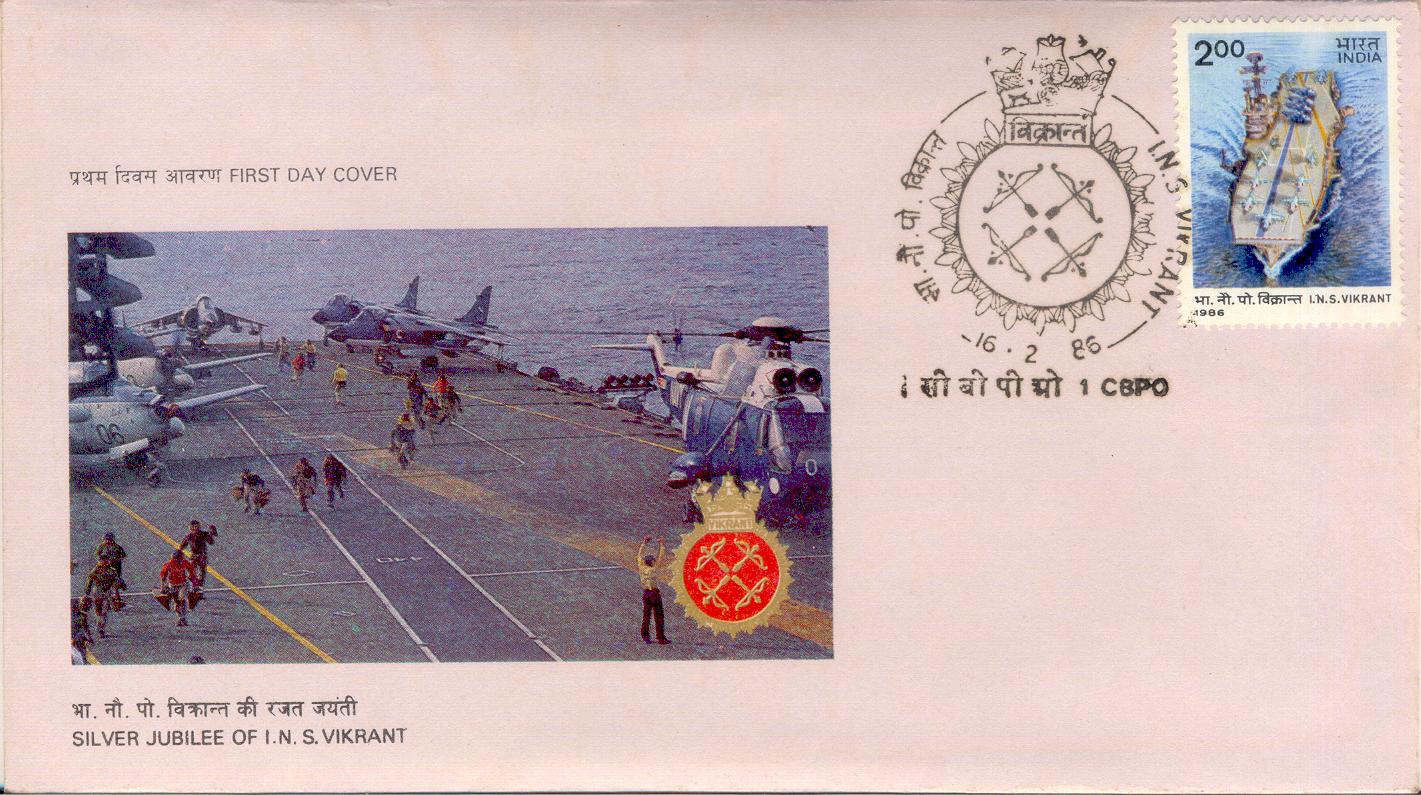
Silver Jubilee of I.N.S. VIKRANT - India's First Aircraft Carrier 16.2.1986

A 200p Stamp on the Silver Jubilee of I.N.S. VIKRANT is based on the art work prepared by Alka Sharma. The First Day Cover shows a Sea Harrier Aircraft ready for take off with Alize aircraft and a Seaking helicopter on either side of the deck ready for launch. The crest of I.N.S. VIKRANT has been superimposed on it.  
  
INS Vikrant was a Majestic-class aircraft carrier of the Indian Navy. She played a key role in enforcing the naval blockade on East Pakistan during the Indo-Pakistan War of 1971.
The ship was built under the name Hercules for the British Royal Navy during World War II, but construction was put on hold after the war's end, and she never entered British service. India purchased the incomplete carrier from the United Kingdom in 1957, and construction was completed in 1961. INS Vikrant was commissioned and was the first aircraft carrier of the Indian Navy. After years of distinguished service, she was decommissioned in January 1997.

The Silver Jubilee of I.N.S. Vikrant, India's only aircraft carrier was on 16 Feb. 1986. Vikrant completed 25 years of glorious service which was a matter of pride not only for the Indian Navy but for the entire country.

03 August 2015

The Naval Dockyard Bombay celebrated its 250th Anniversary on 11 January 1986


The stamp depicts a bird's eye view of the Bombay Dock at the front and the Duncan Dock behind it nearer to the administrative building. These monumental docks, though over 150 years old still serve the needs of Indian Naval Ships and Submarines alike. The first Day Cover depicts the crest of the Naval Dockyard, Bombay. The cancellation is the adaptation of th Logo of its 250th Anniversary Celebration. The stamp, the first day cover and the cancellation have been designed by Capt. Anil Dhir, Indian Navy.

The Naval Dockyard Bombay celebrated its 250th Anniversary on 11 January 1986. From its humble beginning in 1736 from designing and building small crafts, it has developed into a mammoth organisation for repair of the most sophisticated Indian Naval Warships. The Dockyard has become a symbol of rapid progress and technological advancement from repair and building of wooden hulls in 1736 to the repair and servicing of the most sophisticated and advanced electronic gadgets of today. It is the most modern of the Naval Dockyards in South Asia today. The Dockyard commenced functioning on 11 January, 1736, on 120 acres of land sandwiched between the Gateway of India and the Ballard Pier at the entrance of the channel, a purely indigenous enterprise of the Wadia Brothers as a composite unit for designing and building of ships. However the Bombay and Duncan Docks were commissioned in 1758 and 1857, respectively.

10 July 2015

PRESIDENT'S REVIEW OF THE FLEET 12.2.1984


PRESIDENT'S REVIEW OF THE FLEET. The review of the Nation's fleet of warships, by the Heads of the State, is a ceremonial occasion, originating many centuries ago. The earliest record available is that of the Review of the Royal Navy by King Edward III as early as in 1415. Originally, the Review was an opportunity for the Head of State to satisfy himself on the operational readiness of his ships to wage of war at sea. With the passage of time, Reviews were held to mark important events like a coronation, notable anniversaries, visits of important state guests etc. The Indian Navy is normally reviewed by the President, in his capacity as Supreme Commander of the Armed Forces, once during his tenure in office.

The se-tenant set is a composite picture depicting the three dimensional strike capability of the Indian Navy, silhouettes of an aircraft carrier and a vertical Take Off and Landing aircraft, a missile destroyer and a submarine. The three elements viz. the sky, the surface and the ocean depths are represented by a circular band in three shades of blue. The Naval Ensign is repeated in each of the four stamp of the se-tenant. The co-authors of the se-tenant are Captain Anil Dhir, IN and Sudarshan Dheer. The First Day Cover depicts a warship bristling with deadly weapons, the Naval Ensign fluttering proudly in the breeze and the naval crest. The cancellation is an adaptation of the logo of the President's Review representing "Power at Sea". Both the First day Cover and the cancellation have been designed by Commander S. Sekhar, IN.

08 June 2015

Navy Day 1981

The stamp designed by the India Security Press shows Indian Naval Ship TARAGIRI, a Leander Class frigate which was constructed at the Mazagon Dock Shipyard in Bombay. The First day cover illustration shows a helicopter on board an Indian Naval Ship.

The Indian Post & Telegraphs Department issued this special postage stamp on the Indian Navy to commemorate Navy Day 1981. Navy Day is observed on 4th December every year.

08 January 2015

INS Nilgiri

INS Nilgiri (F33) was the lead ship of her class of frigates. Commissioned on June 3, 1972 into the Indian Navy, she was decommissioned in 1996.
INS Nilgiri was the first major warship built in India keel up. It was built at Mazagon Docks Limited, Mumbai in collaboration with Yarrow Shipbuilders, Glasgow. The collaboration involved designs of the Royal Navy's improved Type 12 general purpose frigate and technical and training support for construction of 6 vessels. The project to build Nilgiri was led by Homi Sethna and Commander (later Rear Admiral) Prakash N Gour. The success of Nilgiri led to the Indian Navy along with Mazagon Docks redesigning the last two ships of the class - INS Vindhyagiri and INS Taragiri to add the Sea King helicopter, ILAS 324 mm torpedo tubes and Bofors ASW rocket launcher.
The First Commanding Officer of INS Nilgiri was Captain Oscar Stanley Dawson (later Chief of the Naval Staff).