G. V. Chalam, also known as Guduru
Venkata Chalam (1909–1967), was an
Indian activist and agricultural scientist who received the Padma Shri in 1967.
Welcome to My Indian stamps, first-day covers and postcards gallery. These items have all been collected by me since the age of seven. My desire here, is to show as often as I can, some of my presumed beauties and talk about them. And hopefully make Your Day in the bargain. In case you want a better view, JUST CLICK on the picture and it will be ENLARGED. Please also see my picture postcards blog www.mypicturepostcards.blogspot.in, and also my stamps blog www.letstalkstamps.blogspot.com.
Showing posts with label Agriculture. Show all posts
20 October 2016
31 July 2016
Benjamin Peary Pal 5.1.2008
Benjamin Peary Pal (May 26, 1906- September 14, 1989) was the first Director of Indian Council of Agricultural Research. He was one of the foremost scientists in Wheat genetics and breeding.
20 June 2016
02 June 2016
100 Years of Cooperative Movement in India 8.5.2005
In India, the Co-operative movement was started after the enactment of "The Co-operative Credit Societies Act, 1904 (Act Xof 1904)". On 25th March, 1904 the Bill was passed and on 26th March, 1904 it was published in the Gazette of India. Hence, the year 2004 is being celebrated as the Centenary Year of the Co-operative Movement in India. With that Act, the Co-operative emerged in India as a State sponsored/promoted institution. The main objective was to relieve the poor agriculturists from the clutches of cruel moneylenders. What was the background?
09 February 2016
The 2nd International Crop Science Congress was conducted in New Delhi 17.11.1996
The 2nd International Crop Science Congress was conducted in New Delhi, India in 1996 with the theme “Crop productivity and Sustainability – Shaping the Future”. This conference was jointly organized by International Crop Science Society, National Academy of Agricultural Sciences and the Indian Council of Agricultural Research, New Delhi,
02 November 2015
The Indian Council of Agricultural Research (ICAR) 31.5.1990
The Indian Council of Agricultural Research (ICAR) is an autonomous organisation under the Department of Agricultural Research and Education (DARE), Ministry of Agriculture and Farmers Welfare , Government of India. Formerly known as Imperial Council of Agricultural Research, it was established on 16 July 1929 as a registered society under the Societies Registration Act, 1860 in pursuance of the report of the Royal Commission on Agriculture. The ICAR has its headquarters at New Delhi.
The Council is the apex body for co-ordinating, guiding and managing research and education in agriculture including horticulture, fisheries and animal sciences in the entire country. With 101 ICAR institutes and 71 agricultural universities spread across the country this is one of the largest national agricultural systems in the world.
22 April 2015
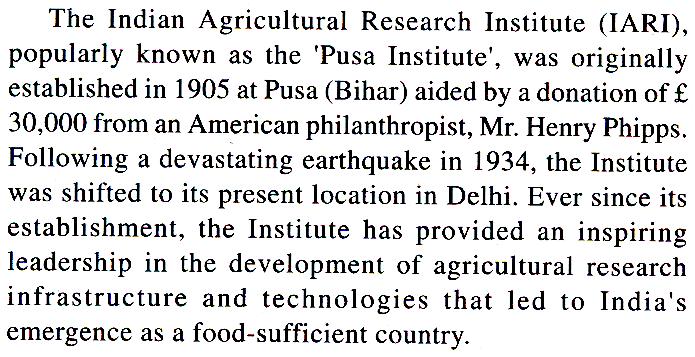
The Indian Agricultural Research Institute (IARI) 23.2.1978
The Indian Agricultural Research Institute (IARI) commonly known as Pusa Institute is India's premier national Institute for agricultural research,
education and extension.
Situated in
Delhi, it is financed and administered by the Indian Council of Agricultural Research (ICAR). The IARI was responsible
for the research leading to the "Green Revolution in India" of the
1970s.
17 April 2015
National Agricultural Exposition (AGRIEXPO 77) 13.11.1977
The biggest ever national agricultural exposition, known as AGRIEXPO 77 was organised by the Trade Fair Authority of India at Pragati Maidan in New Delhi, from November 13 to December 13, 1977. Agriculture is the largest and most widely dispersed industry of India, generating employment opportinities for more than three-fouth of the country's population. The agricultural sctor accounts for nearly 50 per cent of the national income and sustains a substantial portion of export trade of India. AGRIEXPO 77 is projecting the rural sector in the totality, showing all its facets and providing glimpses into its innermost recesses also. The core complex is constituted by the displays arranged by the Ministry of Agriculture and Irrigation. Agricultural practices, research in agricultural sciences, fertilizer and other chemicals and improved varieties of seeds etc. are prominently featured here. Other participants included State Governments, Central Ministers and Departments, trade promotion bodies, firms and undertakings and four foreign countries- Afhanistan, Hungary, Japan and U.S.S.R. Among the major attractions of this Exposition are the Bullock Cart Square and the Rural India Complex.
The stamp depicts a stylised version of a grain stalk.
13 April 2015
Ganga Ram 4.9.1977
Ganga Ram was born on April 13, 1851 at Mangatwala now in Pakistan. After a brilliant academic career he entered service as an Assistant Engineer in the Public Works Department, Punjab. The planning and processes introduced by him for the construction of municipal services, structure and institutions were the first of its kind in India and became a model for generations to come. The most significant contribution of Ganga Ram was in the field of agriculture. To him. agriculture was the foundation of the development of all planning and prosperity in India. His efforts, inspiration and engineering skill largely contributed to making dry tracts of Punjab smile and become green which has made that state the granary of India with the highest per capita income.
Ganga Ram was a great social reformer much ahead of his time. He was against dowry and child marriage and advocated widow re-marriage. He established institutions for vocational education and education of adults. Much of his income was put in a charitable trust named after him. To perpetuate his memory the Ganga Ram Trust, despite having been deprived of almost its entire reserve of funds and property due to partition of the country, is running an up-to-date hospital in New Delhi.
Ganga Ram passed away on July 10, 1927 in England while functioning as an active member of the Royal Commission on Agriculture.
The stamp depicts a portrait of Ganga Ram and shows a view of Ganga Ram Hospital building in New Delhi.
04 April 2015
Diamond Jubilee of Coconut Research in India 27.12.1976
Coconut contributes 1 percent of the GNP and 2 percent of the total agricultural income of India which ranks third in the world production of coconut. India was the first country to take up systematic research on coconut. Research work was started at Kasargod and Nileshar stations of the then Madras Presidency (now in Kerala State) in 1916. The Nileshwar station is now part of the Kerala Agricultural University. The Kasargod station is the headquarters of the Central Plantation Crops Research Institute of the Indian Council of Agricultural research since 1970. These centres are still among the leading coconut research centres if the world.
Evolution of high and early bearing hybrids, development of coconut-based products, management practices and cropping system and control of pests and diseases are notable achievements of research during the last six decades. The root wilt of coconut is a serious problem which is yet to be remedied and concerted efforts are under way to tackle this problem.
The year 1976 marks the Diamond Jubilee of research on coconut. As part of the celebrations, an International Symposium on coconut is also being organised at Kasargod.
A postage stamp to commemorate the Diamond Jubilee of Coconut Research in India was issued.The stamp depicts a young hybrid (between tall and dwarf forms) coconut palm.
03 January 2015
WHEAT REVOLUTION 1968 17.7.1968
Wheat has been grown in India since ancient times and the wheat grains discovered in the Mohenjo-daro excavations belong to a unique species called Tirticum spaerococcum. At present, there are nearly 14 million hectares under this crop, out of which about 4 million are irrigated.
While wheat cultivation in our country is thus one of great antiquity, the yield per hectare was below 800 Kgs. for a long time. Consequently, the gap between demand and supply had grown and shortfall had been largely met hrough import from the United States under the PL 480 programme.
A principal reason for the low yields obtained even in irrigated areas is the tall straw of the older varieties which makes the cultivation of the crop under good conditions of soil fertility and water management difficult. In order to overcome the barriers to high yields, the Indian Agricultural Reasearch Institute, New Delhi, introduced from Mexico in 1963 a wide range of wheat material possesing the genitic factors for dwarfing originally discovered in "Norin" Japanese wheats, through the kind courtesy of the Rockefeller Foundation and the Mexican Ministry of Agriculture.
What is even more significant, the dwarf wheats are not only helping to increase the yield of wheat but are also acting as catalyst in bringing about a total transformation in the outlook and agronomic methodology of our rural community, thus ending the divorce between labour and intellect.
The Posts and Telegraphs Department brought out a special postage stamp to commemorate the "Wheat Revolution"and its significance to our agricultural revolution and economic well-being.
13 September 2014
First World Agriculture Fair in New Delhi 30.12.1959
The First World Agricultural Fair was held in New Delhi in 1959. The
Fair was opened by the President of India Mr. Rajendra Prasad. The Chief
Guest was Dwight D. Eisenhower, the 34th President of the United States. He
declared open the US Pavilion, which was generally acclaimed as the Best
Pavilion on show.
Instead of My talking about the Fair, I’d rather cite from the prepared pamphlet being distributed during the Opening of the Fair. These are excerpts of General Eisenhower’s Opening remarks.
“I am signally honored by the invitation to join President Prasad at the opening of the World Agriculture Fair--the first such fair as this ever held. And it is entirely right that it be held here in India. For this nation recognizes in agriculture the fundamental occupation of man and the chief assurance of better living for its citizens.
My own country was quick to accept when invited to participate in this historic event. And today I am particularly honored that India's Chief of State will be with me when, in a few minutes, I officially open the United States exhibit at the Fair. Indeed, the occasion of this Fair gave me the very finest reason I could think of to make this the time of the visit to India that I had long determined upon.
At this American exhibit, all visitors can see how we Americans have managed the soil of our land so that our people might live well for themselves; and have enough food left over to help others. Our way is not necessarily the best, even for us, but here we depict in the American exhibit, American agriculture as it is. We do have a natural pride in what we have accomplished by a creative union of human spirit, fertile earth, and inventive science. But, beyond this, we see in modern agriculture a most effective instrument for a better life among all men.
For a moment, I hope you will indulge me as I suggest some thoughts on how food can help all of us achieve better lives in a world of justice and peace.
Today, we have the scientific capacity to abolish from the world at least this one evil, we can eliminate the hunger that emaciates the bodies of children; that scars the souls of their parents; that stirs the passions of those who toil endlessly and earn only scraps.
Men, right now, possess the knowledge and the resources for a successful worldwide war against hunger--the sort of war that dignifies and exalts human beings. The different exhibits in this whole Fair are clear proof of that statement.
The call to that genuinely noble war is enunciated in the theme of the American exhibit:
"Food--Family--Friendship-- Freedom."
Into these four words are compressed the daily needs, the high purposes, the deep feelings, the ageless aspirations that unite Indians and Americans under one banner--the banner of human dignity.
Here are four words that are mightier than arms and bombs; mightier than machines and money; mightier than any empire that ruled the past or threatens the future.
Here are four words that can lift the souls of men to a high plane of mutual effort, sustained effort, the most rewarding effort that can be proposed to mankind.
First, Food-food that our bodies may be fit for every task and duty and service; our minds free from the fear of hunger; our eyes undimmed by the tragedies of famine, searching out new horizons; our aspirations not frustrated by failure of crop or catastrophe of weather.
Family--family that in our homes there may be decent living and bright hope; children no longer doomed to misery in peace and sudden death in war; their elders no longer broken by want and sorrow beyond their control to mend or cure.
Friendship--that among all the peoples of earth the darkness of ignorance and fear and distrust will dissolve in the light of knowledge and understanding. The time has come when we must all live together for our mutual betterment or we shall all suffer harsh, possibly the final, penalty.
Freedom--that on all continents and islands of the earth every man and woman of good will and good life may make the proudest of human boasts: "I am free; slave to no tyranny imposed by other men, by the accident of birth, by the whims of circumstance."
Instead of My talking about the Fair, I’d rather cite from the prepared pamphlet being distributed during the Opening of the Fair. These are excerpts of General Eisenhower’s Opening remarks.
“I am signally honored by the invitation to join President Prasad at the opening of the World Agriculture Fair--the first such fair as this ever held. And it is entirely right that it be held here in India. For this nation recognizes in agriculture the fundamental occupation of man and the chief assurance of better living for its citizens.
My own country was quick to accept when invited to participate in this historic event. And today I am particularly honored that India's Chief of State will be with me when, in a few minutes, I officially open the United States exhibit at the Fair. Indeed, the occasion of this Fair gave me the very finest reason I could think of to make this the time of the visit to India that I had long determined upon.
At this American exhibit, all visitors can see how we Americans have managed the soil of our land so that our people might live well for themselves; and have enough food left over to help others. Our way is not necessarily the best, even for us, but here we depict in the American exhibit, American agriculture as it is. We do have a natural pride in what we have accomplished by a creative union of human spirit, fertile earth, and inventive science. But, beyond this, we see in modern agriculture a most effective instrument for a better life among all men.
For a moment, I hope you will indulge me as I suggest some thoughts on how food can help all of us achieve better lives in a world of justice and peace.
Today, we have the scientific capacity to abolish from the world at least this one evil, we can eliminate the hunger that emaciates the bodies of children; that scars the souls of their parents; that stirs the passions of those who toil endlessly and earn only scraps.
Men, right now, possess the knowledge and the resources for a successful worldwide war against hunger--the sort of war that dignifies and exalts human beings. The different exhibits in this whole Fair are clear proof of that statement.
The call to that genuinely noble war is enunciated in the theme of the American exhibit:
"Food--Family--Friendship--
Into these four words are compressed the daily needs, the high purposes, the deep feelings, the ageless aspirations that unite Indians and Americans under one banner--the banner of human dignity.
Here are four words that are mightier than arms and bombs; mightier than machines and money; mightier than any empire that ruled the past or threatens the future.
Here are four words that can lift the souls of men to a high plane of mutual effort, sustained effort, the most rewarding effort that can be proposed to mankind.
First, Food-food that our bodies may be fit for every task and duty and service; our minds free from the fear of hunger; our eyes undimmed by the tragedies of famine, searching out new horizons; our aspirations not frustrated by failure of crop or catastrophe of weather.
Family--family that in our homes there may be decent living and bright hope; children no longer doomed to misery in peace and sudden death in war; their elders no longer broken by want and sorrow beyond their control to mend or cure.
Friendship--that among all the peoples of earth the darkness of ignorance and fear and distrust will dissolve in the light of knowledge and understanding. The time has come when we must all live together for our mutual betterment or we shall all suffer harsh, possibly the final, penalty.
Freedom--that on all continents and islands of the earth every man and woman of good will and good life may make the proudest of human boasts: "I am free; slave to no tyranny imposed by other men, by the accident of birth, by the whims of circumstance."
Subscribe to:
Posts (Atom)