Showing posts with label 1961-1970. Show all posts

28 January 2015

Jamia Millia Islamia - Golden Jubilee 29.10.1970

Golden Jubilee in October, 1970. During these 50 years, whatever the Jamia has done to realise its objectives is before the nation. The educationists and intellectuals of the country have openly acknowledged its services. On the occasion of the Golden Jubilee of Jamia Millia Islamia,  

The stamp is horizontal and depicts a picture of the University Building. At the left hand bottom, the crest of Jamia Millia Islamia is also shown.

27 January 2015

Pandit Iswar Chandra Vidyasagar - 150th Birth Anniversary 26.9.1970

Of the makers of modern Bengal, one of the names to be remembered and cherished most is that of Pandit Iswar Chandra Vidyasagar. The social and literary resurgence of the country in general, and of Bengal in particular in the mid 19th century is, in no small measure, due to his far-searching vision and dynamic lead. 

22 January 2015

Vladimir Ilyich Ulyanov alias Lenin 22.4.1970

Vladimir Ilyich Ulyanov alias Lenin (22 April 1870 – 21 January 1924) was a Russian communist revolutionary, politician and political theorist. He served as head of government of the Russian Soviet Federative Socialist Republic from 1917, and of the Soviet Union from 1922 until his death. Under his administration, the Russian Empire was replaced by the Soviet Union; all wealth including land, industry and business was nationalized. Based in Marxism, his political theories are known as Leninism.

Lenin, along with Leon Trotsky, played a senior role in orchestrating the October Revolution in 1917, which led to the overthrow of the Provisional Government and the establishment of the Russian Socialist Federative Soviet Republic. Lenin was elected to the position of the head of government by the All-Russian Congress of Soviets. Under Lenin's leadership the new government nationalized the estates and crown lands. Homosexuality and abortion were legalized; Lenin's Russia was the first country in the world to establish both of these rights. Free access was being given to both abortion and birth control. No-fault divorce was also legalized, along with universal free healthcare and free education being established. The Bolsheviks fought in the Russian Civil War during which Lenin's government carried out the Red Terror. The civil war resulted in millions of deaths. Lenin supported world revolution and immediate peace with the Central Powers, agreeing to a punitive treaty that turned over a significant portion of the former Russian Empire to Germany. The treaty was voided after the Allies won the war. In 1921 Lenin proposed the New Economic Policy, a mixed economic system of state capitalism that started the process of industrialisation and recovery from the Civil War. In 1922, the Russian SFSR joined former territories of the Russian Empire in becoming the Soviet Union, with Lenin as its head of government. Only 13 months later, after being incapacitated by a series of strokes, Lenin died at his home in Gorki.
After his death, there was a struggle for power in the Soviet Union between two major factions, namely Stalin's and the Left Opposition (with Trotsky as de facto leader). Eventually, Stalin, whom Lenin distrusted and wanted removed, came to power and eliminated any opposition.

Swami Shraddhanand 30.3.1970

Swami Shraddhanand (1856–1926) was an Indian educationist and an Arya Samaj missionary who propagated the teachings of Swami Dayanand. This included the establishment of educational institutions, like the Gurukul Kangri University, and played a key role on the Sangathan (consolidation) and the Shuddi(re-conversion) a Hindu reform movement in 1920s.
His death at the hands of a Muslim caused religious strife in India. On 23 December 1926 he was assassinated by a Muslim fanatic named Abdul Rashid, who entered his home at Naya Bazar, Delhi, by posing as a visitor. Upon his death, Gandhiji moved a condolence motion at the Guwahati session of the Congress on 25 December 1926. An excerpt from the speech in relevant part reads "In the language of the Gita therefore 'happy the warrior who achieves such a blessed death.' ... I cannot therefore mourn over his death. He and his are to be envied. For though Shraddhanandji is dead, he is yet living. He is living in a truer sense than when he moved in our midst in his giant body ....."I have called Abdul Rashid a brother and I repeat it. I do not even regard him as guilty of Swamiji's murder. Guilty indeed are all those who excited feelings of hatred against one another."

Today, the 'Swami Shraddhanand Kaksha' at the Archeological Museum at the Gurukul Kangri University in Haridwar houses a photographic journey of his life.
A statue of him was placed in front of Delhi Town Hall after independence, replacing a statue of Queen Victoria. This location in Old Delhi is termed ghantaghar because the old clock tower stood here until 1950s.

21 January 2015

Nalanda College,- Centenary 27.3.1970

Nalanda College, Biharsharif (Bihar) is the oldest college of the Magadh University. It was established a century back as the Bihar English High School. The first batch of students appeared in the year 1871 from the Calcutta University. Thanks to the munificent donation made by the late Rai Bahadur Edal Singh, its founder, it blossomed into a full-fledged college in 1920. The institution takes its name after the famous and ancient Nalanda University. The institution worked as a school upgraded into a school-cum-intermediate college and renamed 'Nalanda College'. In the year 194, the inatitution was upgraded into a degree college. It is presently a degree college affiliated to the Magadh University (Gaya) catering to both arts and science with about 2,000 students on the roll.  

Nalanda college celebrated its centenary week in the last week of March, 1970. In recognition of its 100 years of useful service to the cause of higher education. The University Grants commision sanctioned a sum of Rs. 1 lakh for the construction of a Centenary Block in the college. On this memorable occasion, the Posts and Telegraphs Department brought out a special postage stamp to commemorate this event.

19 January 2015

Sadhu T. L. Vaswani - Centenary 25.11.1969

Sadhu T. L. Vaswani (November 25, 1879 – January 16, 1966) Sadhu T. L. Vaswani was an Indian educationist who started the Mira movement of education and set up Sadhu Vaswani Mission in Hyderabad, Sindh, and later moved to Pune after 1949. A museum, Darshan Museum dedicated to his life and teaching was opened in Pune, in 2011.

14 January 2015

Serampore College - 150Years 7.6.1969

Serampore College was founded in 1818 by the English missionaries known as the Serampore Trio: -
William Carey.
Joshua Marshman
William Ward


Their aim was to give an education in arts and sciences to students of every "caste, colour or country" and to train people for ministry in the growing church in India (See: Christianity in India).

10 January 2015

Dr. Bhagwan Das 12.1.1969

Dr. Bhagwan Das (12 January 1869 – 18 September 1958) was an Indian Theosophist and public figure. For a time he served in the Central Legislative Assembly of British India. He became allied with the Hindustani Culture Society and was active in opposing rioting as a form of protest. As an advocate for national freedom from the British rule, he was often in danger of reprisals from the Colonial government. He was awarded Bharat Ratna in 1955. He was the first recipient of India's highest civilian award.

With Besant he formed a professional collaboration which led to the founding of the Central Hindu College, which became [[central Hindu school ]]. Das would later found the Kashi Vidya Peeth, a national university where he served as headmaster. Das was a scholar of Sanskrit, from which he added to the body of Hindi language. He wrote approximately 30 books, many of these in Sanskrit and Hindi.

A prominent road in New Delhi is named after him and a colony is also named after his name in Sigra area of Varanasi 'Dr. Bhagwan Das Nagar.'


09 January 2015

Indian Birds 31.12.1968

India is well known for the richness and variety of its flora and fauna. Situated in the tropical and temperate zones with parts of the country receiving heavy rainfall, India is a naturalist's paradise. This series of four stamps on Indian Birds just proves this.
THE RED BILLED BLUE MAGPIE (Urocissa erythrorhyncha) This blue bird is about the size of a pigeon with the two central feathers of the tail 15 to 17 inches long. The head, neck and breast are black and undrparts greyish white. The tail feathers are tipped white. The bill and the legs are crimson. The mail and the female are alike. It is found throughout the Himalayas, upto an altitude of about 10,000 feet. This magpie is a common bird at all West Himalayan hill-stations. Its flight is noisy and slow, but with the long tail spread, a party in flight marks a charming spectacle.
THE BROWN-FRONTED PIED WOOD PECKER (Dryobates himalyansis) The hill bird is about 8 inches long and is common in the forests of Western Himalaya at elevations between 2000 to 7000 feet. Its neck is cross-barred blck and white. There is a red patch nder the tail. The crown in themale is golden-brown in front, crimson behind. The female lacks these colours on its head.
THE YELLOW-BACKED SLATY HEADED SUNBIRD (Aethopyga Siparaja) Of the size of a sparrow, this is a brilliantly coloured, purple, green and crimson sunbird, with a long pointed metallic green tail and a distinctive yellow rump. It is found in moist evergreen forests throughout India. It flits about restlessly like a gem in the sunshine among shrubs, sometimes hanging upside down to probe into flowers for nectar. It also feeds on insects and spiders.
SLATYHEADED SCIMITER BABBLER (Pomaterhhinus schisticeps) A dark-brown bird with white throat and breast, prominent white eye-brows and curved pointed yellow bill, it is found in forested country throughout India. It is a medium-sized bird of a length slightly over 8 inches, the male and the female being alike. It is a shy bird, usually rummaging on the ground under dense under-growth for insects and grubs. Its flight is feeble and illsustained. The male bird's call is flute-like with 4 notes.

04 January 2015

Gaganendranath Tagore - Birth Centenary 7.9.1968

Gaganendranath Tagore (September 18, 1867 – 1938) was an Indian painter and cartoonist of the Bengal school. Along with his brother Abanindranath Tagore, he was counted as one of the earliest modern artists in India.

03 January 2015

WHEAT REVOLUTION 1968 17.7.1968

Wheat has been grown in India since ancient times and the wheat grains discovered in the Mohenjo-daro excavations belong to a unique species called Tirticum spaerococcum. At present, there are nearly 14 million hectares under this crop, out of which about 4 million are irrigated.  

While wheat cultivation in our country is thus one of great antiquity, the yield per hectare was below 800 Kgs. for a long time. Consequently, the gap between demand and supply had grown and shortfall had been largely met hrough import from the United States under the PL 480 programme.

A principal reason for the low yields obtained even in irrigated areas is the tall straw of the older varieties which makes the cultivation of the crop under good conditions of soil fertility and water management difficult. In order to overcome the barriers to high yields, the Indian Agricultural Reasearch Institute, New Delhi, introduced from Mexico in 1963 a wide range of wheat material possesing the genitic factors for dwarfing originally discovered in "Norin" Japanese wheats, through the kind courtesy of the Rockefeller Foundation and the Mexican Ministry of Agriculture.

 What is even more significant, the dwarf wheats are not only helping to increase the yield of wheat but are also acting as catalyst in bringing about a total transformation in the outlook and agronomic methodology of our rural community, thus ending the divorce between labour and intellect.

The Posts and Telegraphs Department brought out a special postage stamp to commemorate the "Wheat Revolution"and its significance to our agricultural revolution and economic well-being.

20 December 2014

Nandalal Bose - Death Centenary 16.4.1967

Nandalal Bose (3 December 1882 – 16 April 1966) was one of the pioneers of modern Indian art and a key figure of Contextual Modernism.

A pupil of Abanindranath Tagore, Bose was known for his "Indian style" of painting. He became the principal of Kala Bhavan, Santiniketan in 1922. He was influenced by the Tagore family and the murals of Ajanta; his classic works include paintings of scenes from Indian mythologies, women, and village life.

Today, many critics consider his paintings among India's most important modern paintings. In 1976, the Archaeological Survey of India, Department of Culture, Govt. of India declared his works among the "nine artists" whose work, "not being antiquities", were to be henceforth considered "to be art treasures, having regard to their artistic and aesthetic value".

15 December 2014

India won gold in Hockey in the 1966 Asian Games 31.12.1966

When India won gold in Field Hockey in the 1966 Asian Games in Bangkok, Thailand.

India Post came out with a stamp to honor the players. Balbir Singh of the Services was one of the four players to be featured on the special commemorative stamp released on 31 December 1966, as a tribute to the Gold medal win at the 1966 Asian Games; the other three were Vinod Kumar, John Victor Peter and Mukhbain Singh.

12 December 2014

Children's Day 1966


The little Child and the Dove of Peace on this stamp symbolise Children's Day 1966 in India.

01 December 2014

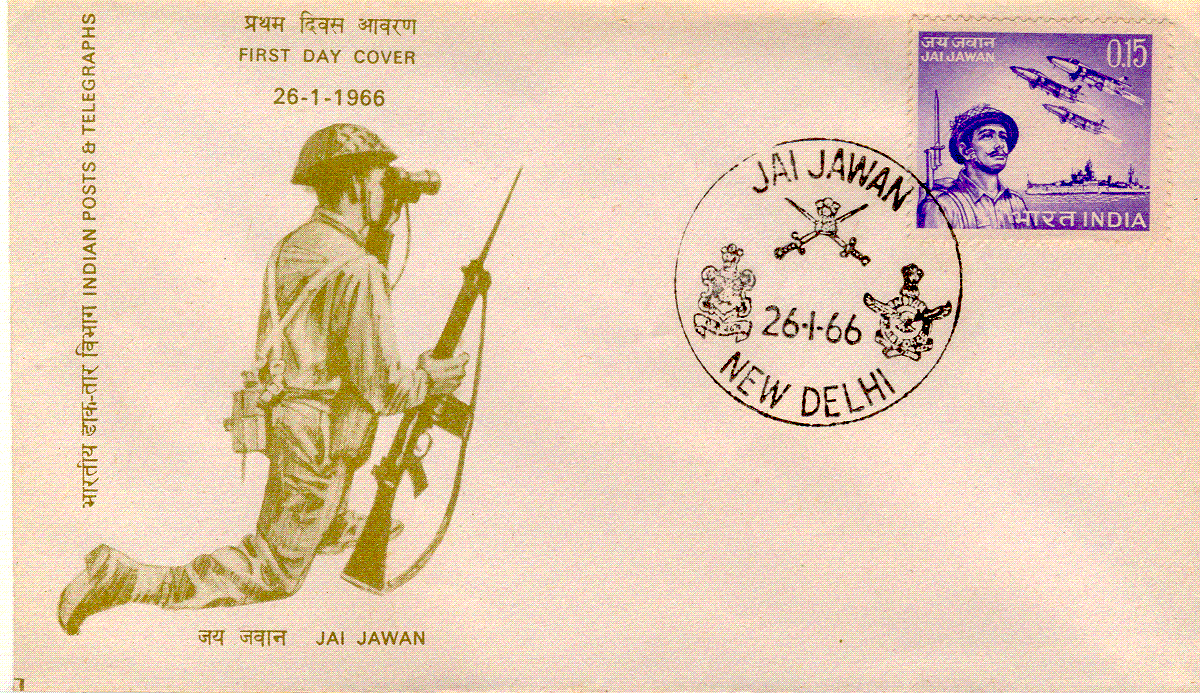
Jai Jawan - Lal Bahadur Shastri's Slogan 26.1.1966

This stamp was issued to commemorate the armed forces on the first republic day after the 1965 War.The stamp, released on 26 Jan 1966 features an army soldier in battle rig, INS Mysore the flag Ship of the Indian Navy and a formation of three Gnat aircraft.  

21 November 2014

Abraham Lincoln - One Hundredth Death Anniversary 15.4.1965


15th April 1965 marked the one hundredth anniversary of the death of Abraham Lincoln, and on this occasion the Indian Posts and telegraphs Department brought out a commemorative stamp in his honour.

ABRAHAM LINCOLN (Born-12th February 1809 Died-15th April 1865) On 15th April 1965, the Death Anniversary of Lincoln the It is a fact of history that nations produce men who are equal to the times. India had Mahatma Gandhi to guide her in her struggle for freedom. To the United States of America came Abraham Lincoln in her hour of tribulation. The ideals for which Abraham Lincoln stood have a special significance for us in India since they were so akin to those of the Father of Mahatma Gandhi. Separated as they were by space and time, these two great leaders were motivated by two basic convictions-belief in the common man and belief in the ultimate triumph of truth. As it happened, both of them laid down their life for the cause, which was dearest to their hearts.

Lincoln, the 16th President of United States of America, was called to the helm of affairs in 1861 at a time when that country was on the verge of a civil war over the question of the abolition of the Negro slavery. The civil war, which lasted for four long years, ended in victory for the northern states, thanks to Lincoln's stewardship. His leadership and indomitable courage were a bulwark against the forces of reaction and outmoded beliefs. He earned the gratitude of his countrymen by preserving the Union of the States of America and of millions of Negro's by abolishing slavery. His creed was simple-- "As I would not be a slave, so I would not be a master. This expresses my idea of democracy. Whatever differs from this, to the extent of difference, is no democracy." He had faith in people, in the basic goodness of men and in democracy. 'God must like the common people', he said,' or he would not have made so many of them'. He believed that'no man is good enough to govern another man without that other man's consent’.

14 November 2014

Children's Day 1964

Today is the National Children's Day in India. It is also, the 125th Birth Anniversary of Pandit Jawahar Lal Nehru, the first Prime Minister of India.


Children's day commemoration stamp November 14, 1964. The  Posts and Telegraphs Department has, since the year 1957, been bringing out special stamps to mark Children's Day each year on the 14th November.

The special stamp issued in 1964 commemorates not only Children's Day but also the seventy-fifth birth anniversary of the late Prime Minister. The design of the stamp has been adapted from the commemorative coin of the denomination of one rupee, which was separately issued on the 14th November 1964. The stamp bears the inscription 'Chacha Nehru' (uncle Nehru) at the top and 'Bal Din' (Children's Day) below it.

10 November 2014

Asutosh Mookerjee - Birth Centenary 29.6.1964

Dr. Asutosh  Mookerjee was born in Calcutta on the 29th June, 1864, into a middle-class family. His father, who was a noted physician of his day, looked to his education himself. Young Asutosh was a mathematical prodigy, and even while he was a schoolboy, his original contribution to mathematics won appreciation overseas.

On the 29th June, 1964, which is the Birth Centenary of Dr. Asutosh Mookerjee, the Posts & Telegraphs Department issued a special commemorative stamp in honour of this great lawyer, a great judge and above all a great educationist.

07 November 2014

Kasturba Gandhi 22.2.1964

This stamp was issued on the 20th Death Anniversary of Kasturba Gandhi.

Kasturba Mohandas Gandhi (11 April 1869 – 22 February 1944) was the wife of Mohandas Karamchand Gandhi. In association with her husband, Kasturba Gandhi was a political activist fighting for civil rights and Indian independence from the British.