Showing posts with label Exhibitions and Fairs. Show all posts

07 July 2016

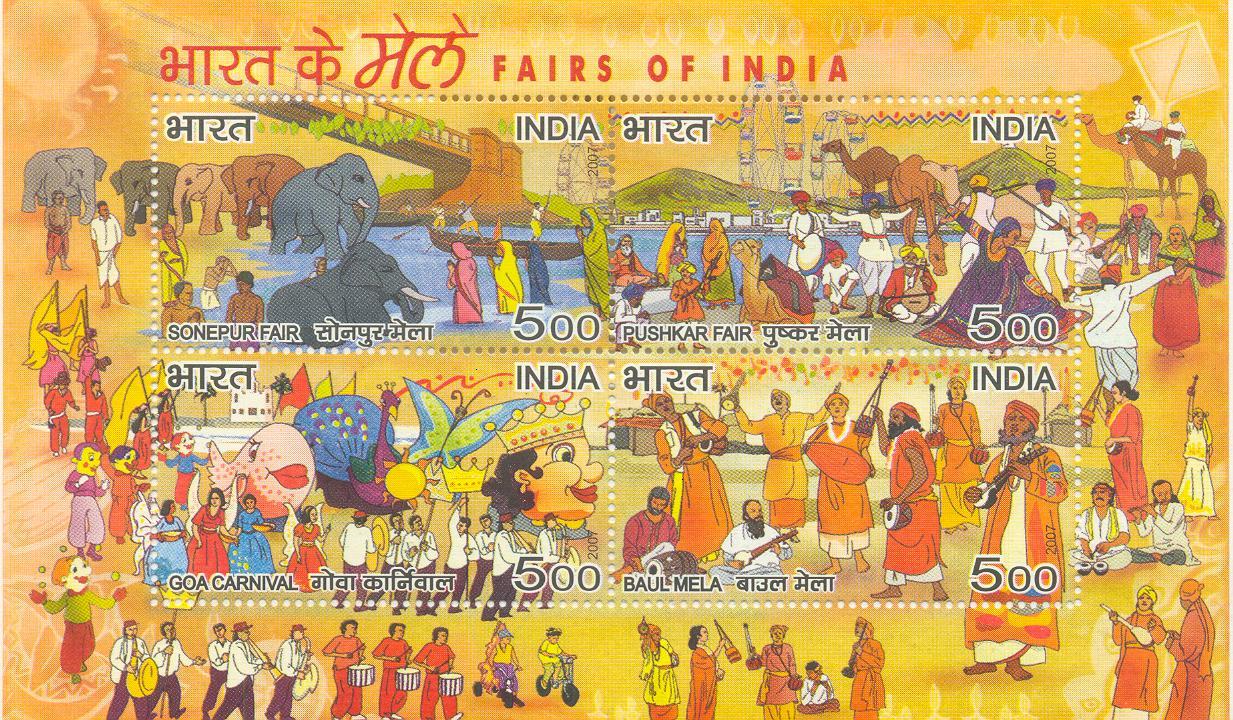
Fairs of India 27.2.2007

In bringing out a set of four commemorative stamps on the “Fairs of India” the Department of Posts celebrates the unique character of each, while also celebrating the rich variety of our country’s socio–cultural heritage.
lndia has a very rich tradition of ‘Melas’ or fairs, many dating back to times long ago and drawing crowds of people from far and near. A focal point of socio-economic activities of the region, the fairs are vibrant and colourful spectacles, presenting a kaleidoscopic panorama of sight and sound. Steeped in local tradition, each fair has its own unique flavour, its own significance and history.
Through a set of four stamps on ‘Fairs of India‘, India Post showcases the spectacular variety of melas held in different parts of the country.
The Goa Carnival is one of the most famous of these, a three-day riotous festival of music and dance, laughter and fun. The origin of this celebration can be traced back to the early years of Portuguese colonization of the state and, over the years, the carnival has emerged as an intrinsic part of the Goan cultural scene. Held in mid-February, every year, the three-day extravaganza starts with a mammoth procession of floats, of a variegated pageantry of colour and gaiety, headed by King Momo on the evening of ‘Fat Saturday’. This is followed by a host of cultural events and competitions, with enthusiastic participation of locals and tourists who flock to Goafor the carnival.
At the other end of the cultural spectrum is the Pushkar mela. Held annually during the Hindu month of Kartika (October-November), this is one of the largest cattle fairs in the world. Though dealing primarily with camels, a lot of other cattle such as horses, donkeys, bulls etc. are also bought and sold, after being beautified, raced, and paraded on the sands this small lake-side town, near Ajmer in Rajasthan. The fair represents an extraordinary melding of commerce and devotion, as Sadhus (holy men) and devotees, musicians and folk dancers, acrobats and other entertainers, along with traders and tourists descend on the town in hordes. Camping in tents outside the town, the rural folk congregate to take a holy dip in the sacred lake next to the temple consecrated to Lord Brahma, the only one of its kind in the world.
The Sonepur fair in Bihar is also supposed to be one of Asia‘s largest cattle fairs specializing in the sale of elephants. Sonepur is situated at the confluence of the holy rivers Ganga and Gandak, about 40 kms from Patna, and has been a center for the animal trade since the fourth century B.C. Chantagupta Maurya  , the great Indian emperor who ruled the country from Pataliputra (now Patna) in those days is said to have bought elephants and horses for his army from Sonepur. Other animals traded at Sonepur include cattle, dogs, birds, and even monkeys. A holy bath at the confluence of the holy rivers, and a visit to the Hariharnath temple situated here are the other attractions that draw thousands of devotees here on the Kartika Purnima day, apart from the normal mela entertainment like jugglers and folk shows, and stall selling foodstuffs and all manner of things.
The Baul festivals of West Bengal provide a study in contrast. Their itinerant life-style, religious philosophy, poetical compositions, and musical style was brought into prominence through the writings of Rabindranath Tagore/. The Bauls have been using the melas or fairs since time immemorial, to spread their message of universal brotherhood and love among the rural people. While a number of such melas are held in different parts of Birbhum District of West Bengal throughout the year, the two best-known ones are the Jaydev –Kenduli Mela, and the Poush Mela atSantiniketan. While the Poush Mela has become a major tourist destination, the Jayadeva-Kenduli Mela better retains its original flavour, serving as a meeting place for the Bauls to come together and share their oral tradition of spiritual songs and music.
13 November 2015

7th Triennale 12.2.1991

An attractive Commemorative stamp to mark the 7th Triennale Art Exhibition held at N.Delhi was issued by India in 1991.

14 May 2015

The 4th World Book Fair, New Delhi 29.2.1980

The stamp depicts a few books arranged in the form of a circle, giving the impression of a moving wheel suggesting the dynamic force of the printed world. The first day cover illustration is a view of a book fair. The first day cancellation design is based on the Sanskrit word Rita (rita -hindi), the central order which transforms chaos and confusion into symmetry and beauty and from which originated the primeval speech carrying the seeds of knowledge and truth.
The 4th World Book Fair, organised at New Delhi by National Book Trust, India, in collaboration with the Indian Book Trade, is the most important book event in India, perhaps in the whole Asia. Since its inception in 1957, National Book Trusat, India, is engaged in the primary task of promoting bookmindedness in the country. The trust has also been assisting in the overall growth of the publishing industry. To fulfil this dual objective, the Trust, on the one hand, has been publishing interesting titles in English and in Indian Languages on a wide variety of the subjects and, on the other, organising national and international book fairs in the important centres in India. The Trust has so far organised three World Book fairs, the first in 1972, the second in 1976 and the third in 1978.

10 May 2015

1979 Year of the Child - International Children's Book Fair 10.11.1979

Children's Book Trust celebrates the Year of the Child by organising the International Children's Book Fair in New Delhi from November 10-19, 1979 and dedicates it to the children of the world. The P & T Department is happy to mark the occasion with the issue of a commemorative stamp. 

The stamp depicts a child with books.

The 1979 India International Trade Fair 10.11.1979

The India International Trade Fair 1979 being held at Pragati Maidan in New Delhi is the first International Trade Fair organized by TFAI in India. The theme of the Fair is ?trade for prosperity?. The fair covers all aspects of industry, agriculture, trade, science and technology. Nearly 30 countries of the world are participating in the Fair. All the State Governments, many Central Ministries, Public Under-takings, Export Promotion Councils, Commodity Boards and Private firms are also taking part in it. Indian P & T Department is happy to commemorate the India International Trade Fair 1979 by issuing a special post age stamp.


The stamp depicts the logo of the Trade Fair Authority of India.

30 April 2015

1978 National small Industries Fair 17.11.1978

Small Scale-Industries constitute a vital sector in India?s economy. Small Scale units comprise 75% of the registered factories accounting for nearly 30% of employment and contributing over 40% of industrial production. The respective figures will be even more, if unregistered units are taken into account. Its total contribution to GNP is nearly 13%, which is more than the heavy industries sector. Production of electronics, which is regarded as an index of national economic growth, is heavily concentrated in the small sector. What is of greater significance is that the large industries are heavily dependent on the small units for ancilliaries. In some cases finished products on the large scale sector consist of as high a proportion as 80% from the small sector.

The 1978 National small Industries Fair organised by the Trade Fair Authority of India is the national projection of this vital sector covering the entire gamut of products from sophisticated electronics and modern engineering items to traditional handicrafts and products of the cottage and tiny units including village industries. The Fair is symbolic of Gandhiji’s “Back to the village” movement and has been organised in accordance with the socio-economic objectives and priorities of the Government.

The theme of this Fair is ”Small Industry serves the People”. The display will provide a close view of the different facts of small industry sector, both in State pavilion presenting a composite show. An exclusive export potential of the small and cottage industries.  


14 February 2015

ASIA 72 - Industrial Exhibition. New Delhi 1972

Indian transition and achievements down the ages. This is done with the help of multiple projection techniques. Seeking to promote "Peace and Progress for Asia through economic co-operation" the Fair adopted for its symbol a stylised representation of the hand of Buddha, a sign of freedom from fear and as a mark of benediction to all mankind. The elements of the insignia represent the initials of the Fair nomenclature.
This insignia of Asia 72 appears on the 20 Paise stamp brought out on this occasion. A 9th century sculpture representation of the hand of Buddha in 'Abhaya Mudra' is adopted on the Rs. 1.45 stamp. The original sculpture is available in Patna Museum. The Posts and Telegraphs Department commemorated the opening of Asia 72 on 3rd November, 1972 through the issue of these stamps.

13 September 2014

First World Agriculture Fair in New Delhi 30.12.1959

The First World Agricultural Fair was held in New Delhi in 1959. The Fair was opened by the President of India Mr. Rajendra Prasad. The Chief Guest was Dwight D. Eisenhower, the 34th President of the United States. He declared open the US Pavilion, which was generally acclaimed as the Best Pavilion on show.
Instead of My talking about the Fair, I’d rather cite from the prepared pamphlet being distributed during the  Opening of the Fair. These are excerpts of General Eisenhower’s Opening remarks.
“I am signally honored by the invitation to join President Prasad at the opening of the World Agriculture Fair--the first such fair as this ever held. And it is entirely right that it be held here in India. For this nation recognizes in agriculture the fundamental occupation of man and the chief assurance of better living for its citizens.
My own country was quick to accept when invited to participate in this historic event. And today I am particularly honored that India's Chief of State will be with me when, in a few minutes, I officially open the United States exhibit at the Fair. Indeed, the occasion of this Fair gave me the very finest reason I could think of to make this the time of the visit to India that I had long determined upon.
At this American exhibit, all visitors can see how we Americans have managed the soil of our land so that our people might live well for themselves; and have enough food left over to help others. Our way is not necessarily the best, even for us, but here we depict in the American exhibit, American agriculture as it is. We do have a natural pride in what we have accomplished by a creative union of human spirit, fertile earth, and inventive science. But, beyond this, we see in modern agriculture a most effective instrument for a better life among all men.  
For a moment, I hope you will indulge me as I suggest some thoughts on how food can help all of us achieve better lives in a world of justice and peace.
Today, we have the scientific capacity to abolish from the world at least this one evil, we can eliminate the hunger that emaciates the bodies of children; that scars the souls of their parents; that stirs the passions of those who toil endlessly and earn only scraps.
Men, right now, possess the knowledge and the resources for a successful worldwide war against hunger--the sort of war that dignifies and exalts human beings. The different exhibits in this whole Fair are clear proof of that statement.
The call to that genuinely noble war is enunciated in the theme of the American exhibit:
"Food--Family--Friendship--Freedom."
Into these four words are compressed the daily needs, the high purposes, the deep feelings, the ageless aspirations that unite Indians and Americans under one banner--the banner of human dignity.
Here are four words that are mightier than arms and bombs; mightier than machines and money; mightier than any empire that ruled the past or threatens the future.
Here are four words that can lift the souls of men to a high plane of mutual effort, sustained effort,  the most rewarding effort that can be proposed to mankind.
First, Food-food that our bodies may be fit for every task and duty and service; our minds free from the fear of hunger; our eyes undimmed by the tragedies of famine, searching out new horizons; our aspirations not frustrated by failure of crop or catastrophe of weather.
Family--family that in our homes there may be decent living and bright hope; children no longer doomed to misery in peace and sudden death in war; their elders no longer broken by want and sorrow beyond their control to mend or cure.
Friendship--that among all the peoples of earth the darkness of ignorance and fear and distrust will dissolve in the light of knowledge and understanding. The time has come when we must all live together for our mutual betterment or we shall all suffer harsh, possibly the final, penalty.
Freedom--that on all continents and islands of the earth every man and woman of good will and good life may make the proudest of human boasts: "I am free; slave to no tyranny imposed by other men, by the accident of birth, by the whims of circumstance."

09 September 2014

India 1958 Exhibition 30.12.1958

The year 1958 witnessed probably the best organised Exhibition so far held in India at a national level. Organised in  record time, the Exhibition comprising nearly 300 pavilions and stalls divided in 22 centres, truly pictured the evolution of a new India since Independence under the impact of successive Five year plans. India was in the middle of the Second Five Year Plan and substantial progress has been made in most of the projects forming the core of the plan. The Exhibition provided splendid opportunities to demonstrate to the people of India the various development plans and stages of progress achieved and to impress upon the people that the Plan was for the people and not the people for the Plan. To that extent India 1958 was a great success.

The 15nP stamp on the FDC depicts the impressive gate/entrance to the exhibition.