
Showing posts with label Composer. Show all posts
Showing posts with label Composer. Show all posts
28 November 2015
Mozart 5.12.1991

18 November 2015
Ariyakudi Ramanuja Iyengar 15.5.1991

14 September 2015
Svāti Tirunāl Rāma Varma 2.5.1988

Svāti Tirunāl Rāma Varma (16 April 1813 – 27 December 1846) was the Maharaja of the Kingdom of Travancore, British India. He is also considered as a brilliant music composer and is credited with over 400 classical compositions in both Carntic and Hindusthani style.
A well-formulated code of laws, courts of Justice, introduction of English education, construction of an observatory, installation of the first Government printing press, establishment of the first manuscripts library were amongst the many initiatives taken by Svāti Tirunāḷ, as a King, to modernise Travancore. 'Efficiency was the key word and corruption a taboo', according to the article The Monarch Musician in The Hindu.
02 August 2015
Bach and Handel 27.12.1985
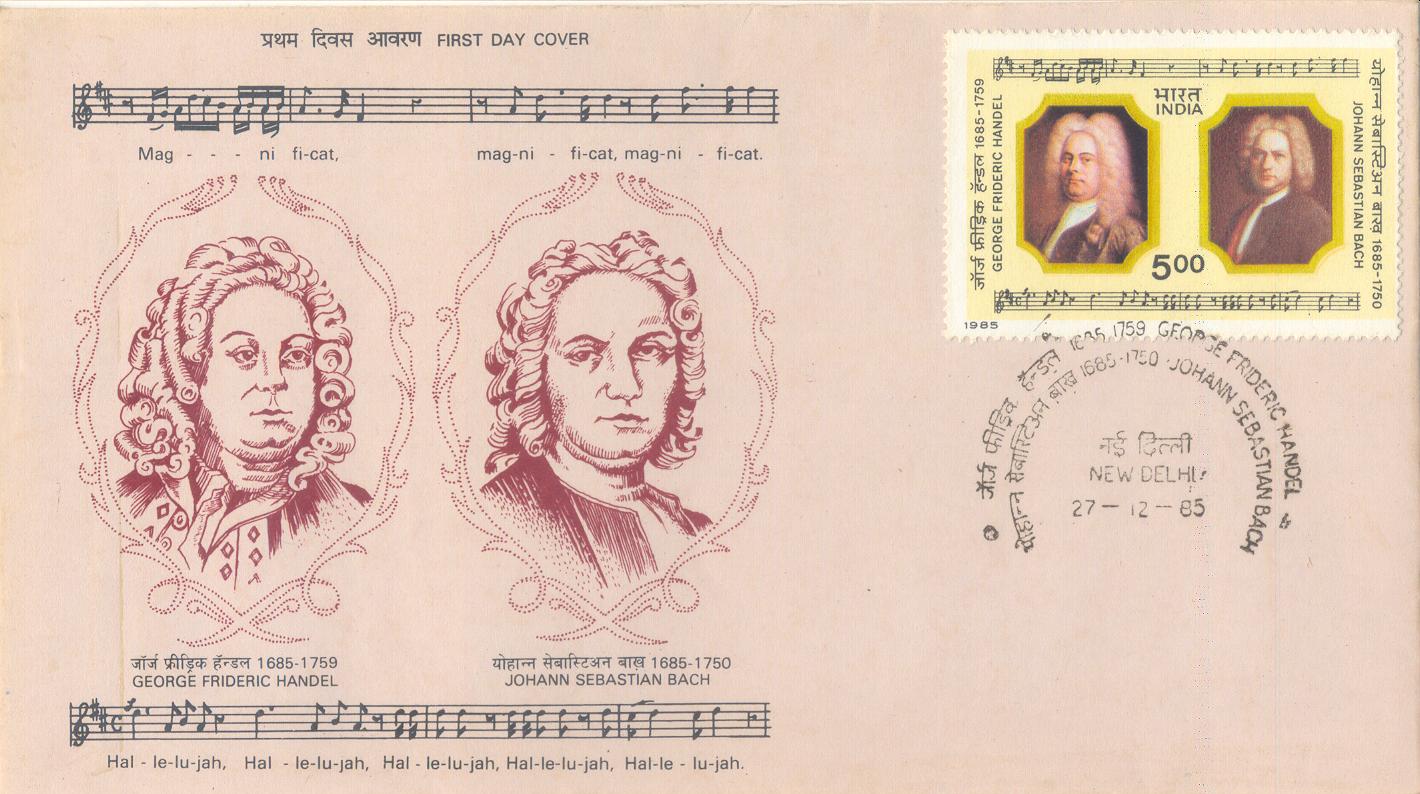
In spite of fierce wars which devastated Germany, during which all other arts suffered terribly, music actually advanced in its development of truly human expression. The wealth of folk-song and church music, including the Passion, then acquired by Germany, is still one of its greatest treasures; and polyphonic art, which had so sadly declined in Italy, found a new opportunity for development and growth at the hands of the great German organists.
The time was now ripe for the arrival of two great musical geniuses, not only the greatest in Germany but in the world of that day, Bach and Handel.
George Frideric (or Frederick) Handel (born Georg Friedrich Händel 23 February 1685 – 14 April 1759) was a German-born, British Baroque composer who spent the bulk of his career in London, becoming well known for his operas, oratorios, anthems, and organ concertos. Born in a family indifferent to music, Handel received critical training in Halle, Hamburg and Italy before settling in London (1712), and became a naturalized British subject in 1727. He was strongly influenced both by the great composers of the Italian Baroque and the middle-German polyphonic choral tradition.
Johann Sebastian Bach (31 March 1685 – 28 July 1750) was a German composer and musician of the Baroque period. He enriched established German styles through his skill in counterpoint, harmonic and motivic organisation, and the adaptation of rhythms, forms, and textures from abroad, particularly from Italy and France. Bach's compositions include the Brandenburg Concertos, the Goldberg Variations, the Mass in B minor, two Passions, and over three hundred cantatas of which nearly two hundred survive. His music is revered for its technical command, artistic beauty, and intellectual depth.
03 May 2015
Franz Peter Schubert 25.12.1978

Franz Peter Schubert who was born inVienna in 1797 and died there in 1828, ranks as one of the greatest composers of western classical music. Schubert was the son of a school-master of modest means, but he had the advantage of being a member of an intensely musical family whose string-quartet performances were renowned in their area. Greatly admired as he was by a discriminating circle of friends and music-lovers, he never became rich, and there was a time when he would write down a song just to cover the cost of a meal. Music flowed naturally and effortlessly from Schubert.
His output over his short life-span of 31 years was prodigious. While capable of rising to great heights of dramatic intensity and power in his magnificent Symphony No. 9 in C, Schubert is widely remembered and loved for his exquisite sense of melody enshrined in his matchless songs, which have given joy and inspiration to millions of music-lovers all over the world. On the occasion of his 150th death anniverasarywhen India pays her tribute to this great son of Austria, it is gratifying to learn that among Schubert's compositions is one on the theme of a great classic of India, "Shakuntala".
On his death in 1828, a year after the death of Beethoven, whom he idolised, Schubert was buried beside Beethoven, two great geniuses nurtured in the creative atmosphere of Vienna.
04 April 2015
Bankim Chandra Chattopadhyay - Vande Mataram - 30.12.1976

Rishi Bankim Chandra Chattopadhyay; ("Chattopadhyay" or "Chatterji" as spelt by the British) (27 June 1838 – 8 April 1894) was a Bengali writer, poet and journalist. He was the composer of India's national song Vande Mataram, originally a Bengali and Sanskrit stotra personifying India as a mother goddess and inspiring the activists during the Indian Independence Movement. Bankim Chandra wrote 13 novels and several 'serious, serio-comic, satirical, scientific and critical treaties' in Bengali. His works were widely translated into other regional languages of India as well as in English.
'Vande Mataram', the immortal song composed by Bankin Chandra Chaterjee, is more than a hundred years old. Though it first appeared in the first instalment of serialisation of Bankim Chandra's Bengali novel, Anand Math, in 1881, there is clear evidence to show that it was composed independently earlier in 1875. Writing in the English Daily, 'Bande Mataram', on 16th April 1907, Sri Aurobindo said: "It as 32 years ago that Bankim wrote his great song.....". In his novel Anand Math, Bankim Chandra rote about sanyasis who left their hearths and homes and dedicated their lives to the cause of their motherland. The characters in his novel personified the motherland as the Mother Goddess and worshipped her as such. They knew no other deity excepting the motherland and no other religion excepting the religion of patriotism. This spirit was reflected in the song 'Vande Mataram'.
Although Rabindranath Tagore's song, Jana-gana-mana, was adopted as the national anthem of Independent India, Vande Mataram was given an equal status with Jana-gana-mana.
The stamp shows the first stanza of the song "Vande Mataram".
04 November 2014
Poet Purandaradasa - 400th Death Anniversary 14.1.1964

This
fdc was issued to commemorate the 400th Death Anniversary of Poet
Purandaradasa.
Purandara Dāsa (1484–1564)
was a prominent composer of Carnatic music. He is widely referred
to as the Pitamaha (the
father or the grandfather) of Carnatic Music in honour of his significant
contribution to Carnatic music. He
formulated the basic lessons of teaching Carnatic music by structuring graded
exercises known as Swaravalis and Alankaras,
and at the same time, he introduced the Raga Mayamalavagowla as
the first scale to be learnt by beginners in the field. He also composed Gitas (simple
songs) for novice students.
Purandara
Dasa addressed social issues in addition to worship in his compositions, a
practice emulated by his younger contemporary, Kanakadasa.
Purandara Dasa's Carnatic music compositions are mostly in Kannada;
some are in Sanskrit.
He signed his compositions with the mudra (pen
name), "Purandara Vittala" (Vittala is one of the incarnations of the god, Vishnu).
20 September 2014
Tyagaraja Aradhana Day 6.1.1961

Tyagaraja
Aradhana is an annual Carnatic
music festival held in January and
February. Many exponents of Carnatic
music come to perform and are watched
by thousands of ardent fans of Indian
classical music. It is associated with the world famous singer and saint Tyagaraja and is
one of the most important music festivals in India.
Kakarla
Tyagabrahmam (4 May 1767 – 6 January 1847), colloquially known as Tyāgarāju or Tyāgayya in
Telugu, Tyāgarājar in
Tamil, was one of the greatest composers of Carnatic music or Indian
classical music. He was a prolific composer and
highly influential in the development of the classical music tradition.
Tyagaraja composed thousands
of devotional compositions, most in praise of Lord Rama, many of which
remain popular today. Of special
mention are five of his compositions called the Pancharatna
Kirtis (English: "five gems"),
which are often sung in programs in his honour.
Subscribe to:
Posts (Atom)