A set of three Commemorative Postage Stamps on Swachh Bharat Mission (Clean India Mission) were issued. These stamps were released in order to achieve the vision of a Clean and Healthy India. Department of Posts has selected the design for the stamps through a competition among children on the theme of Swachh Bharat Mission. Swachh Bharat Mission was launched by the Prime Minister on 2nd October, 2014 on the occasion of Birth Anniversary of Father of the Nation- Mahatma Gandhi. This mission seeks to achieve a Clean India and aims to provide access to toilets in all households in the country. It also seeks to provide adequate arrangements for Solid and Liquid Waste Management.
Welcome to My Indian stamps, first-day covers and postcards gallery. These items have all been collected by me since the age of seven. My desire here, is to show as often as I can, some of my presumed beauties and talk about them. And hopefully make Your Day in the bargain. In case you want a better view, JUST CLICK on the picture and it will be ENLARGED. Please also see my picture postcards blog www.mypicturepostcards.blogspot.in, and also my stamps blog www.letstalkstamps.blogspot.com.
Showing posts with label Health. Show all posts
27 January 2017
22 January 2017
15th anniversary of India's 1st successful liver transplant 4.11.2014
The Stamp on the FDC was released to celebrate the 15th anniversary of India's 1st successful liver transplant performed at Apollo Hospitals!
The only definite treatment for liver failure is a liver transplantation. During a liver transplant, the diseased liver is removed and replaced with a healthy one.
The first successful Liver Transplantation was performed on a child in 1967. Since then, there has been tremendous progress in the complicated process of liver transplantation, which in 1983 was confirmed to be a valid procedure in cases of end stage liver disease(ESLD), in a consensus by the National Institutes of Health. The first successful liver transplantation in India was performed at IndraprasthaApollo Hospital on 15thNovember, 1998 in New Delhi.
17 September 2016
India's Lifeline Express 12.5.2009
H. E. Shri S. C. Jamir, Governor of Maharashtra, released a National Postage Stamp at Raj Bhavan honouring Impact India's Lifeline Express - the world's first hospital train on May 12, 2009 in Mumbai - a project in partnership with the Indian Railways. He also launched Impact India's book, "Creating Rainbows" covering its innovative journey over 25 years.
The LifeLine Express has two state of the art operating theatres, recovery rooms offices and accommodation. And for each project a team of volunteer doctors, surgeons and nurses give their services for free. For four weeks cameras follow the Mandsor project, the train carries out operations on poor rural people whilst standing in a station in the middle of India. The operations change the lives of the patients and the doctors. Compelling, dynamic and moving stories, LifeLine Express leads us through a gateway into another India - where 21st century medicine meets village India.
27 July 2016
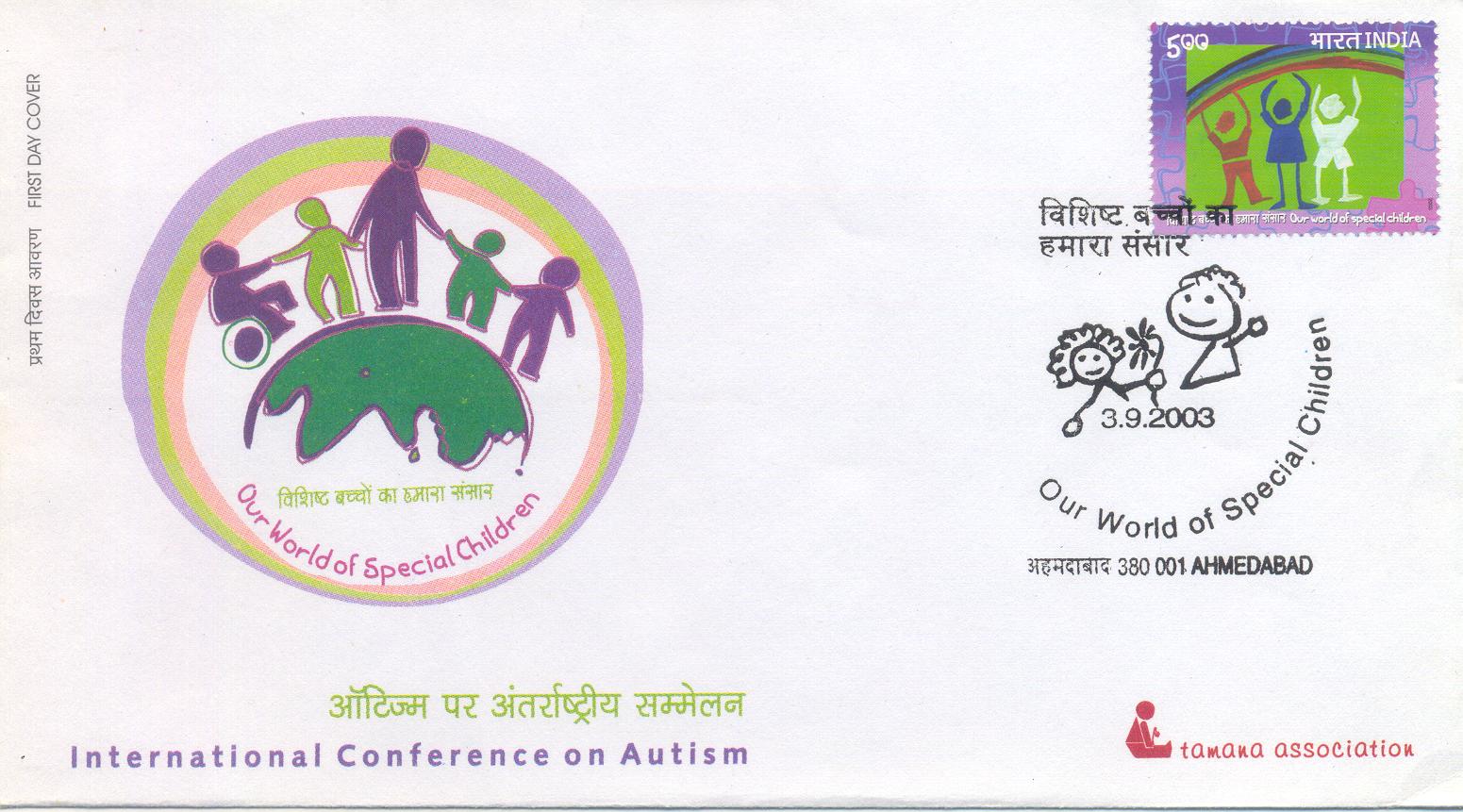
International Day of Disabled Persons 3.12.2007
The annual observance of the International Day of Disabled Persons on 3rd December, aims to promote an understanding of disability issues and mobilize support for the dignity, rights and well being of persons with disabilities. It also seeks to increase awareness of gains to be derived from the integration of persons with disabilities in every aspect of political, social, economic and cultural life. The theme of the Day is based on the goal of full and equal enjoyment of human rights and participation in society by persons with disabilities, established by the World Programme of Action concerning Disabled Persons, adopted by General Assembly in 1982.
The stamp is a tribute to the spirit of persons with disabilities. For the first time, the denomination of the stamp is mentioned in Braille script. The first Day cover also bears inscuptions in Braille.
03 July 2016
10 June 2016
Newborn Health in India 24.11.2005
This stamp was issued to highlight the importance of New born Health, and the pathetic state of it in India. India needs to put greater focus on saving newborn lives In India, as some statics aver that 760,000 newborns die each year.
04 May 2016
12 April 2016
25 March 2016
20th Congress of The International Congress of Radiology (ICR), New Delhi 18.9.1998
The 20th Congress of The International Congress of Radiology (ICR) was held in New Delhi in 1998.
The International Congress of Radiology (ICR) is a meeting of radiologists for the exchange of ideas and the harmonisation of international standards and practice, first held in 1925 in London and held at regular intervals since then. Since 1994 it has become a biennial event. Until 1953 each congress was organised by radiological society of the host country, but in that year, a formal organisation, the International Society for Radiology was set up to provide continuity between the congresses.
30 January 2016
27 January 2016
Yellapragada Subbarow 19.12.1995
Yellapragada Subbarow (12 January 1895 – 8 August 1948) was an Indian biochemist who discovered the function of adenosine triphosphate as an energy source in the cell, and developed methotrexate for the treatment of cancer. Most of his career was spent in the United States. Despite his isolation of ATP, Subbarow was denied tenure at Harvard though he would lead some of America's most important medical research during World War II. Subbarow died in the United States. Subbarow is also credited with the first synthesis of the chemical compounds folic acid and methotrexate.
Subbarow's colleague, George Hitchings, who shared the 1988 Nobel Prize in Physiology or Medicine with Gertrude Elion, said, "Some of the nucleotides isolated by Subbarow had to be rediscovered years later by other workers because Fiske, apparently, did not let Subbarow's contributions see the light of the day." A fungus genus was named Subbaromyces in his honor. Writing in the April 1950 issue ofArgosy, Doron K. Antrim observed, "You've probably never heard of Dr. Yellapragada Subbarow. Yet because he lived you may be alive and are well today. Because he lived you may live longer."
08 January 2016
20 December 2015
29 November 2015
15 November 2015
05 September 2015
28 August 2015
100 years of service to the blind 15.10.1987
Louis Braille's system of embossed reading and writing has lifted the burden of helplessness from the blind. The first school was established in India in 1887 at Amritsar. This year completes a century of service to the blind. Bharati Braille, the all-India system of reading and writing, was accepted by the Government of India in 1951. The blind have kept pace with technology development, working at telephone operating, computer programming, electronic assembly and production of electronic items. Among other concessions, the government reserves posts for blind. The All India Confederation of the Blind provides the essential solidarity and guidance. The blind have come a long way from charity to social equality and independence. Material for text, courtesy: Times Eye Research Foundation and All India Confederation of the Blind.
The Re1.00 stamp is on Eye Donation, and the Rs2.00 stamp is on 100 years of service to the blind.
ROTARY INTERNATIONAL - ASIA REGIONAL CONFERENCE, NEW DELHI, 14.10.1987
The 60P stamp depicts the Asia Regional Conference of the Rotary International at New Delhi from 12th to 15th October. The Rs.6.50 stamp depict the Polio Immunisation Programme undertaken by Rotary.
11 July 2015
The XII International Leprosy Congress, New Delhi 20.2.1984
The scientific era of leprosy began in 1873 when Gerhard Armauer Hansen published his observation ofMycobacterium leprae in materials from leprosy patients. The principal opposition to Hansen's view that leprosy was an infectious disease came from Daniel Cornelius Daniclssen (his father-in-law) and Carl Wilhelm Boeck in "Traité de la Spedalskhed ou Elephantiasis des Grecs". Those who considered it a hereditary disease. This book was the standard reference book on leprosy from 1848 until the death of Danielssen in 1895.
The XII International Leprosy Congress was in New Delhi. Important Indian research work is recognized. The ICRC and the "'Mycobacterium w" vaccines are promising. Mother Teresa asks the members of the Congress to cure patients and to pray for them. Mahatma Gandhi was very fond of nursing leprosy patients. On one occasion he was invited to speak at the inauguration of a new hospital for leprosy patients, and he expressed his feeling that he would be much happier if he had been invited to the closure of a leprosy hospital. Now the Gandhi Leprosy Memorial continues his work.
The stamp, designed by J. P. Irani, depicts the emblem of the International Leprosy Association flanked by two faces of the globe.
13 June 2015
The centenary of the Discovery of Tubercle Bacillus - Robert Heinrich Herman Koch 24.3.1982
The centenary of the Discovery of Tubercle Bacillus is being celebrated with the dual object of honouring the great man who discovered this bacillus and also highlighting the need for augmenting the resources and strengthening the health services and developing these in such a manner that control of tuberculosis is achieved as early as possible.
Robert Heinrich Herman Koch (11 December 1843 – 27 May 1910) was a celebrated German physician and pioneering microbiologist. The founder of modern bacteriology, he is known for his role in identifying the specific causative agents of tuberculosis, cholera, and anthrax and for giving experimental support for the concept of infectious disease. In addition to his trail-blazing studies on these diseases, Koch created and improved laboratory technologies and techniques in the field of microbiology, and made key discoveries in public health. His research led to the creation of Koch’s postulates, a series of four generalized principles linking specific microorganisms to specific diseases that remain today the "gold standard" in medical microbiology. As a result of his groundbreaking research on tuberculosis, Koch received the Nobel Prize in Physiology or Medicine in 1905.
Subscribe to:
Posts (Atom)