Showing posts with label postal. Show all posts

01 January 2017

11th Asian Pacific Postal Union Congress 3.9.2013


11th Asian Pacific Postal Union Congress was held in New Delhi from 3rd to 6th September2013. On 3rd September2013, The President of India inaugurated the congress.  Special stamps portraying the wild flowers of India were issued on the occasion. A miniature sheet of these stamps is shown above. 
India has a rich and varied heritage of plant diversity exhibiting a wide spectrum from tropical rain–forests to alpine vegetation and from temperate forests to the coastal wetlands. The Flora of India is one of the richest in the world due to its diverse climatic regimes and topology. There is virtually no area in India without a particular treasure or species of special beauty or interest.

India Post is paying a tribute to the pristine beauty of twelve of its rare and beautiful wild flowers by issuing a sheetlet of stamps and three miniature sheets.

27 December 2016

Heritage Buildings of Mumbai GPO & Agra HPO 12.4.2013


The Mumbai G.P.O. is built in Indo–Saracenic style with a solid exterior and well ventilated interiors built in local Kurla basalt with dressings of yellow stone from Malad and white stone from Dhrangadhara. The architecture reflects strong influences of Islamic architecture in its skyline dominated by domes and minarets. The monumental structure stretches to a length of 522 feet. The height of the dome is 119 feet. The facade is symmetrical along the central axis, with the centre punctuated by a front porch and capped by a dome. The dome fashioned after the Bijapur dome has a diameter of 65 feet. The building is listed as a Grade–l heritage building in the Heritage Regulation for Greater Bombay, 1995.
Mumbai G.P.O. has come a long way since its birth and has evolved into a modern fully computerized post office representing the changing face of India Post.

Agra Head Post Office was built in 1913. It is located on the Mall Road of the beautiful cantonment area of Agra.
Agra H.P.O. building, an important landmark of Agra has two beautiful porches on both sides and a 45 feet high dome in the middle of the building. The building also finds a place in the list of Postal Heritage buildings. Keeping with the times, this office is also fully computerized.

20 October 2016

Postal Heritage Buildings 13.5.2010

DELHI GPO is among the very few buildings of lndia Post which has been given the status of “Heritage Building” by the Archaeological Survey of lndia and is in close proximity to the historical Red Fort and Chandni Chowk.
SHIMLA GPO on the Mall, established in 1883 on the site of a house known and as “Conny Lodge”, is one of the oldest Post Office buildings in the country.
UDAGAMANDALAM HPO The first Post Office at Udagamandalam was opened in 1826 with an establishment of a writer and two delivery peons. There are no records as to where the office originally was. In the earliest plan of Ootacamund (1829) the building which afterwards became the Post Office is shown and marked as Government Bungalow. Records show that in November 1833, the Post Office was at Rays house.
COOCH BEHAR HPO In 1875 the Post & Telegraph Office of Cooch Behar State is learnt to have been introduced under the administrative control of Rangpur Postal Division. The Cooch Behar Post Office was initially functioning in the building situated in the Purana Post Office Para.
NAGPUR GPO considered the mother institution in the Postal Circle of the Central Province, is housed in a majestic Victorian building, once the seat of erstwhilePostmaster General of CP & Berar.

LUCKNOW GPO is an example of relatively more contemporary engineering and architecture. Constructed with red bricks and lime stone, iron was not used in its construction.

27 September 2016

India Post Freighter 12.10.2009

In August 2007, Department of Posts introduced its first dedicated freighter aircraft for exclusive carriage of mail, parcel and logistics in the North East. Lack of a reliable mode of mail transmission in the difficult terrain of this region had always remained a major handicap for India Post in fulfilling its universal social obligations with respect to mail transmission and delivery. This path-breaking effort has not only resolved the chronic problem of transmission of mail, to and from the North East, but has also provided a robust cargo link to the region with rest of the country. The North East freighter, which operates on the Kolkata – Guwahati – Imphal – Agartala – Kolkata route on a regular basis, has in many ways become a lifeline for the entire region. It has given a major fillip to the economic and commercial activities in the region by providing a fast and reliable channel of transmission.

India Post has now put in place a nationwide hub and spoke system of air transmission of mail, parcel and logistics through induction of two or more dedicated freighter aircraft on the metro routes. The North-East freighter has been integrated into this national network, wherein three freighter aircraft operate overnight, converge at Nagpur for exchange of mail, and return to their respective base cities. Cities such as Delhi,Mumbai, Chennai, Kolkata and Bangalore in the metro sector, and Guwahati, Imphal and Agartala in the North East, are directly connected by this freighter network. This network is further complimented by a second tier air transmission as well as a road-cum-rail based transport system for inter-city carriage of mail across the vast expanse of the country. The three Boeing 737–200 freighters operate on the following routes:
Mumbai – Nagpur – Mumbai.
Kolkata – Delhi – Nagpur – Delhi – Kolkata (The same aircraft operates on Kolkata – Guwahati –Imphal – Agartala – Kolkata route during the day time).
Bangalore – Chennai – Nagpur – Chennai – Bangalore.

India Post has chartered these aircraft from Air India. Each aircraft carries eight pallets (seven pallets of 125 inches x 88 inches and one pallet of 108 inches x 88 inches) and a payload of approximately 13 to 14 tonnes. Thus, approximately 40 tonnes of mail, parcel and logistics can be carried on the three aircraft at a time.

On 13th September 2009 the Hon’ble Minister for Communication & IT, Thiru A. Raja, formally launched the freighter aircraft at Chennai, after the trial run which began on 27th July 2009 was found successful.

06 June 2016

The Letter Box 10.10.2005

In the sesquicentennial year, the Department of Posts issued a set of four commemorative postage stamps depicting the Victorian Letter Box, the Penfold Letter Box, the Cylindrical Letter Box and the TV type box, respectively.
           
The ubiquitous letter box is perhaps the best symbol of the outreach of the postal service in the remotest corners of India. Unassuming, yet instantly recognizable, the letter box has been part and parcel of our everyday lives, an icon of stability in an ever-changing world. The Letter Box has witnessed the phases of change and evolution of postal services in our country as well as in the rest of the world, and has itself undergone several incarnations.  Historically they have been of different shapes and sizes, combining functionally while also representing the authority of the state and its prerogative of being the sole provider of postal service in the country.

20 May 2016

150 Years of India Post 4.10.2004

President A P J Abdul Kalam inaugurated the year-long celebrations of India Post on completion of its 150th year in service.
The event was marked by the release of a set of four commemorative stamps in the denomination of Rs 5 each and also release of a commemorative coin by the Prime Minister Manmohan Singh.
The postal services in India commenced with a skeletal network of 701 post offices under the control of a Director General on October 1, 1854. Today, the postal network has 1,55,000 outlets in the country which is the largest in the world.
The British Postal system in India was established by Lord Clive in 1776 which was further developed by Warren Hastings who established the Calcutta GPO in 1774 followed by Madras GPO in 1786 and the Bombay GPO in 1793.
The Post Office Act of 1854 reformed the earlier postal system providing total monopoly to the Government for the management of post Offices and the exclusive privilege for conveyance of letters whereas the 1837 Act united the Post Office organisations in all the three presidencies into one All India Service.


13 January 2016

200 Years of the Bombay GPO 28.12.1994


The General Post Office, Mumbai, is the central post office of the city of Mumbai, India. The post-office handles most of the city's inbound and outbound mail and parcels. Situated in the vicinity of Victoria Terminus, this outstanding structure is a paradigm of Indo-Saracenic architecture.
The general post office is modelled on the Gol Gumbaz in Bijapur, Karnataka. It was designed by British architect John Begg, a consultant architect to the British government. Begg designed the structure in 1902, and construction began on 1 September 1904. It was completed on 13 March 1913 at a cost of ₨ 1,809,000. Black basalt, with a dressing of yellow Kurla stone and white stones from Dhrangdra are the predominant materials used.
The building has an area of 120,000 square feet (11,000 m²) and replaced the current Central Telegraph Office at Flora Fountain as the new GPO. The chief feature of the architecture of this building is an ethereal central hall which rises up to the great dome.

27 October 2015

Sir Gurunath Venkatesh Bewoor KCIE, 20.11.1989

Sir Gurunath Venkatesh Bewoor KCIE (1888 – 1950) was a senior Indian civil servant. He served on the Viceroy's Executive Council during World War II and was the first Indian director of the Post and Telegraph department of India. He later served as Managing Director of Air India.

24 October 2015

Pigeon Post 3.11.1989

The Pigeon is man's close companion and exhibits no fear in his presence. Pigeons have a natural habit of returning unerringly to their homes after a flight. From the Khalif of Baghdad, Sultan Narrudin's regular post covering his entire state in 1146 AD., recorded pigeon messages have been used on many interesting occasions. The message of victory in the Battle of Waterloo sent from Waterloo to London in 1815 was a notable one. During World War I "Cheer-Am 1", a homing pigeon of the American Army, helped in saving a lost American battalion from being captured by the Germans. In India, Chandragupta Maurya, Emperor Ashok and the Mughal Emperors used pigeons as message carriers. The Orissa Police is the only state force in India to have adopted and maintained this method of communication since 1946.They procured 40 pigeons from the departing colonial government at the close of the Second World War. The force now has a strength of 1926 Homing Pigeons spread over 17 plice districts of the state.

The Orissa Police has achieved immense results in times of emergencies, natural calamities, riotous situations and times of stress and strain, by the use of carrier pigeons. During the Postal centenary celebrations of 1954 at Delhi the Homing Pigeons of the Orissa police gave a successful demonstration, by conveying the message of inauguration from the President to the Prime Minister. When the foundation stone of the largest, Hirakud, Dam was to be laid by Prime Minister Nehru on 13-4-48, he desired certain changes in the public meeting scheduled at Cuttack. The Homing pigeon of the State Police transported his message from Sambalpur to Cuttack 400 km. away in hours, to his great delight.

25 September 2015

India-89 World Stamp Exhibition, Delhi in January 1989 (3rd Issue) - The special cancellation for World Post Day 9.10.1988


The 4.00 stamp depicts the Bangalore G.P.O. The 5.00 stamp shows the Bombay G.P.O. The first day cover carries an extract from the letter of the Court of Directors of the East India Company to the Council at Bombay dated 27th Aug., 1688. The special cancellation for World Post Day carries the logo of the Universal Postal Union.  

The present third set consisting of two stamps are on Postal buildings depicting Bombay G.P.O. and Bangalore G.P.O. as samples of early & the latest architecture herald India-89 World Stamp Exhibition, Delhi in January 1989.

08 August 2015

200 Years of The Madras General Post Office 9.10.1986

Madras G.P.O. is one of the three unique offices in the country called as Presidency Offices, the other two being Bombay and Calcutta.

Madras General Post Office was initially opened in Fort St. George Square, just outside the Sea Gate, on 1 June 1786. The first Postmaster-General was Sir Archibald's secretary, A. M. Campbell. Robert Mitford was appointed the Deputy Postmaster-General. The GPO was served by one writer (clerk), five sorters, a head peon and ten postmen. Later, the company overruled Campbell's appointment and, eventually, Oliver Colt was appointed the first Postmaster-General of Madras.

19 June 2015

100 Years of Post Office bank 23.10.1982

100 YEAR OF POST OFFICE SAVINGS BANK. 1st April, 1882 was epoch making day in the history of popular banking in India. It was on that day the Post Office Savings Bank took shape in the country on the authority of the Government Savings Bank Act, 1873. Government banking had earlier existed in India but only as Government Savings Bank in three Presidency towns, in Calcutta from 1833, in Madras from 1834 and in Bombay from 1835, and as District Savings Banks at District Headquarters from 1870. These were restricted efforts and, therefore, their impact was modest. The advent of the Post Office on the scene resulted in a big increase in the number of banks, accounts and deposits.
The experiment of Post Office as bank was a great success, which finally led to the merger of District Savings Banks in the Post Office Savings Bank on 1st April, 1886, when the Government Saving Bank became a Post Office monopoly.

17 February 2015

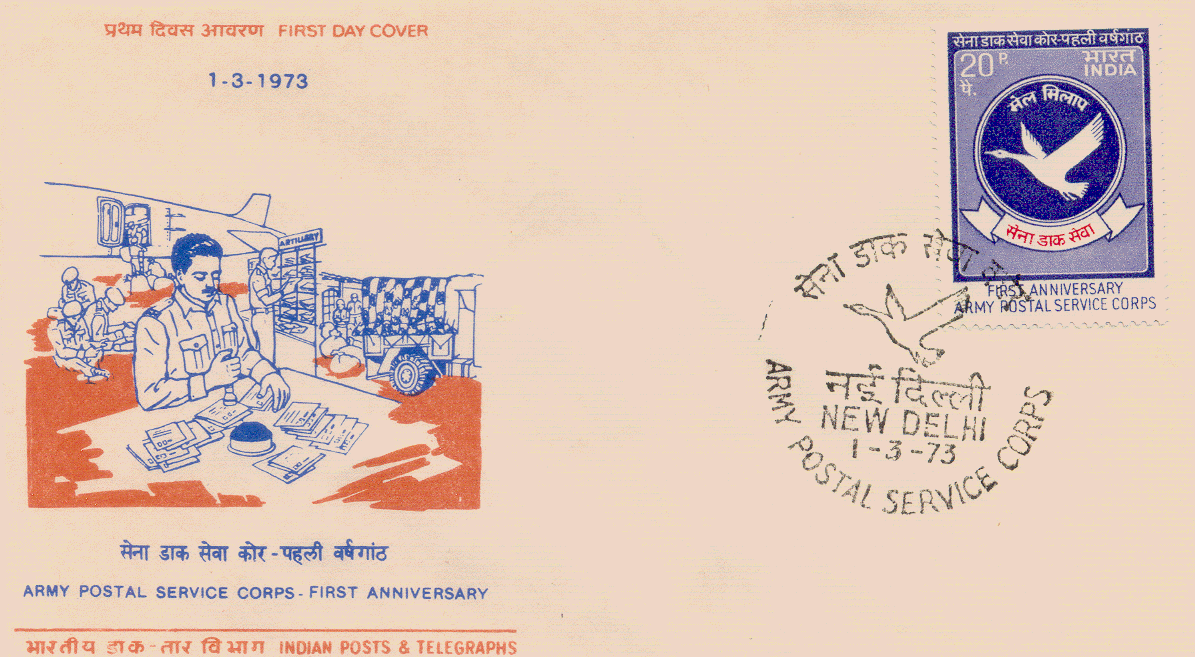
The Army Postal Services First Anniversary 1.3.1973

The Army Postal Services celebrated the first aniversary of its formation into a separate Corps of the Regular Army in 1973. The first Indian Field Post Office was sent to Persia in 1856 and since then FPOs have accompanied the Forces wherever they have operated in Asia, Africa   and Europe. Since Independence, APS has enhanced its reputation for selfless service during the Jammu and Kashmir operations and the subsequently in 1962, 1965 and 1971.

APS also distinguished itself by providing excellent postal facilities to our peace missions to Korea, Indo-China, Gaza and the Congo.  

APS was constituted into a permanent Corps of the Army on 1 March 1972. It has chosen 'Raj Hans' (Swan), a mythical carrier of messages of love, as its symbol and 'Mel Milap' (Amity nd Concord) as its motto. These are depicted in the APS emblem approved by the President which is the motif of the commemorative stamp.

27 August 2014

India Postage Stamps - Centenary - 1st October 1954


On 1st October 1954, India completed 100 Years of the issue of its First Postage Stamp, which also coincided with the placing of the Post Offices under the centralised control of a Director General. India has the unique honour of being the first country in Asia to issue postage stamps. Many  ideas were mooted to celebrate the Centenary, by the Director General of Posts, which gave birth to many controversies. Details of such controversies are recorded in India’s Stamp Journal (1954 issues). One of the controversies was, about the venue for the Centenary Exhibition. Calcutta had a claim because the First Indian Stamp was printed at the Surveyor - General’s Office at Calcutta. Bombay had also a claim because Bombay was the hub of philatelic activities in India. But the Government of India decided to hold India Postage Stamp Centenary and International Stamp Exhibition at Eastern Court, Queensway, New Delhi, from 1st to 15th October 1954. Both Bombay and Calcutta were not happy with the decision and decided to hold independent stamp exhibitions at Bombay and Calcutta in October and December respectively. 

Department issued an attractively bound printed Souvenir Album containing facsimile reproductions in original colours of all postage stamps issued during the last 100 Years The album contains 24 plates housing all 206 stamps issued in between 1854 and 1954, together with a brief write up of stamps. The sale price was Rs.25/- only. This volume was prepared and printed by Nasik Security Press, by the photogravure process. It appears that India is the first country in the world to have produced such a representative record of stamps issued during the past 100 Years.

Another Souvenir Album containing India’s Post Independence Postage Stamps in mint condition was also issued for Rs.65. A Book on the history of Indian Post Office along with the history of India Postage Stamps was also brought out. It was edited by Sri Mulk Raj Anand and was priced Rs.15/- only.

To celebrate the historic occasion of the Centenary of India Postage Stamps on 1st October 1954, the Department issued four commemorative stamps, in denominations of 1 anna, 2 annas, 4 annas and 14 annas depicting the different modes of carrying mails during these 100 Years.