
Showing posts with label 2001-2010. Show all posts
Showing posts with label 2001-2010. Show all posts
10 November 2016
Immanuel Sekaranar 31.12.2010

09 November 2016
The Lalit Kala Akademi 31.12.2010

The Lalit Kala Akademi or National Academy of Art is India's national academy of fine arts. It is an autonomous organisation, established in New Delhi in 1954 by Government of India to promote and propagate understanding of Indian art, in and outside the country.
LKA provides scholarships and a fellow program, and sponsors and organises exhibitions in India and overseas. It publishes a bilingual journal. It is funded by the Union Ministry of Culture. Its headquarters are at Ravindra Bhawan, Ferozshah Road, New Delhi. In April 2015, Government of India took over management control of Lalit Kala Akademi citing complaints regarding alleged administrative and financial irregularities in its functioning.
National Council of Education and Dr. Triguna Sen 24.12.2010

Dr Triguna Sen was born on 24 December 1905 at Sylhet (now part of Bangladesh).· The prestigious national honour of Padma Bhushan was conferred on him in 1965. In 1967 he was inducted into the Union Cabinet as the Minister for Education. It was during his tenure in 1968 as Education Minister, the National Education Policy was formulated. The National Council of Education, Bengal, is the parent body of the Jadavpur University.
The National Council of Education (or NCE) was an organisation founded by Indian nationalists in Bengal in 1906 to promote science and technology as part of a swadeshi industrialisation movement. It established the Bengal National College and Bengal Technical Institute which would later merge to form Jadavpur University. Institutions functioning under the Council were considered to be hotbeds of swadeshi activities and the government banned nationalistic activities such as the singing of patriotic songs.
08 November 2016
100 Years of Central Bank of India 23.12.2010

The Central Bank of India was founded on 21st December 1911 by Sir Sorabji Pochkhanawala a visionary with a desire to start a commercial bank owned by Indians & for Indians. The birth of the Bank with its Indian shareholders, Indian staff and Indian customers was the crystallization of Sir Sorabji‘s dream of setting up a truly “Swadeshi Bank”. Sir Sorabji proclaimed with pride that Central Bank was the property of the nation and the country’s asset and added that, Central Bank lives on people’s faith.
Bhai Jiwan Singh 23.12.2010

Baba Jiwan Singh (also spelled Jivan and Jeevan) (Bhai Jaita before baptism) (1649–1705) was a Sikh General and an accomplice, companion and friend of Guru Gobind Singh, the tenth Guru of the Sikhs. As well as his military prowess he was a poet and a warrior. He eventually became a Sikh martyr and an icon when he fell during the siege of Chamkaur in 1705 against the Mughal armies. He also taught gatka, shabad kirtan, archery, horse riding, and swimming to Baba Ajit Singh, a son of Guru Gobind Singh.
07 November 2016
Shri Bhausaheb Hiray 22.12.2010
Shri Bhausaheb Hiray was born on 01st March 1905 at Nimgaon, a small village in Nashik district. Shri Bhausaheb Hiray had a strong conviction that education is the only tool with which the poverty of the people can be rooted out. His life’s mission was to provide good education. He formed “Nimgaon Vibhag Prasarak Mandal” and Adivasi Sewa Samiti and opened schools & hostels.
 Whether it was building up the cooperative movement, fostering unity between Hindus and Muslims, imparting good education, tribal movement, launching of Koyna Dam getting the Tillers Act implemented; the role of Shri Bhausaheb Hiray was truly commendable. In 1960, he led a delegation to Japan and successfully voiced India‘s concern on Nuclear Proliferation. He passed away on 06th November 1961.
Yashwantrao Balwantrao Chavan 22.12.2010

06 November 2016
Crafts Museum 21.12.2010.
The Crafts Museum was established in 1956 as a resource centre for traditional Indian handicrafts and hand-looms. The aim of the Museum is to preserve Indian art or ethnography and to build a collection of craft specimens. The Museum is housed in Pragati Maidan, New Delhi under aegis of Development Commissioner for Handlooms, Ministry of Textiles, and Government of India.
 The Museum has a collection of 32000 artifacts. Research and Development has been a regular activity of the Crafts Museum. It has been observed that this unique Museum is serving all sections of society, including foreign visitors interested in India rich heritage. The Museum has completed 53 years of service in the field of handicrafts and handlooms and rendered yeoman service in the promotion of Indian heritage and culture.


Joint Issues : India – Mexico - 60 Years of diplomatic relations between India and Mexico 15.12.2010
The theme of this joint issue of Indo-Mexican stamps was ‘Mankind (Clothes & costumes) , Kalbelia Dance & Jarabe Tapatio’.
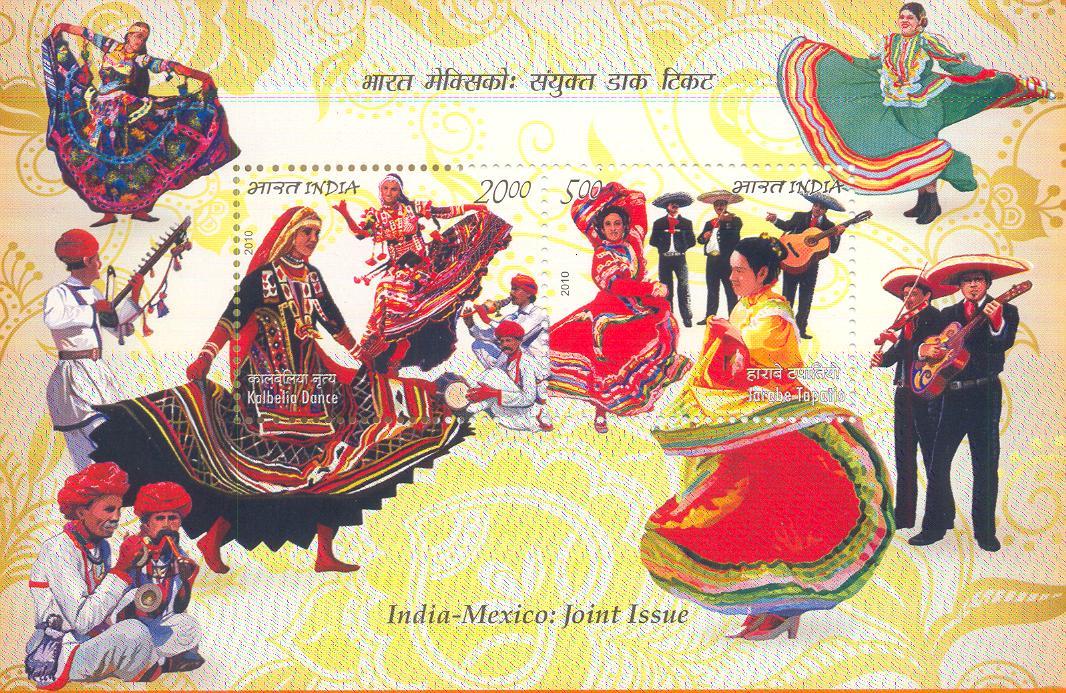
Kalbelia or Kabeliya is one of the most sensuous dance forms of Rajasthan, performed by a tribe of the same name. They are famous for their dance which is an integral part of their culture. Both men and women in the tribe participate in this activity to celebrate joyful occasions. The dancers embellish themselves in traditional black skirts with silver embroidery. The dance, set to folk songs, reminds one of the graceful movements of a snake. The sensual rhythm increases in tempo and vigour with the increase of the beat. Male participants take care of the musical part of the dance. They use different instruments (such as Pungi, Dufli, Been, Khanjari, Morchang & Dholak) to create the rhythm on which the dancer performs.

Jarabe Tapatío, or the Mexican hat dance, is the best known of a variety of Mexican folk dance called the jarabe. Each region and state in Mexico presents the Mexican dance form in a style that reflects its own unique customs and traditions. It is one of the most beloved dance forms in Mexico and is considered as the national dance of Mexico. While the women wear the traditional china poblana, which includes a fringed blouse, a skirt and a shawl, the men are dressed in an ornate charro or cowboy suit. The dance gained immense popularity when the famous ballerina, Anna Pavlova, incorporated it in her repertoire.
05 November 2016
Prafulla Chandra Chaki 11.12.2010

Sri Sri Amarendranath Chakravarty popularly known as Sri Sri Borda 6.12.2010

Sri Sri Amarendranath Chakravarty popularly known as Sri Sri Borda was born on 21st November 1911 at Himayetpur, in Pabna district of Bengalprovince, now in Bangladesh to Sri Sri Thakur Anukulchandra and Smt. Jagat–Janani Sree Sree Shorashibala Devi.
He raised a volunteer force called Swasti Sevak Vahini by drafting youths and taught them to maintain social peace, harmony and to provide necessary service to the people. A de-addiction centre for the drug addicted was opened where thousands of people are treated. He made the Ashram Hospital give free medical treatment to the needy and destitute. Artificial limbs to the handicapped are being distributed free of cost. In the free community kitchen thousands are fed.
He was ever ready to come to the aid anyone who needs it. With his sympathetic attitude he endured the weak and the wicked; encouraged the daunted and the destitute. He consoled the aggrieved, relieved and the sufferers held up the fallen and led them to the light of life.
04 November 2016
TN Tajarathinam Pillai, Thanjavur Balasaraswathi and Veenai Dhanammal 3.12.2010

The musicians portrayed on the tree stamps on the FDC are TN Tajarathinam Pillai, Thanjavur Balasaraswathi and Veenai Dhanammal.
Thiruvaduthurai Thirumarugal Natesapillai Rajarathinam Pillai (27 August 1898 – 12 December 1956) was a Carnatic musician in South India, a Nadaswaram maestro and a vocalist. He was known as TNR.
Tanjore Balasaraswati, also known as Balasaraswati (13 May 1918 – 9 February 1984), was a celebrated Indian dancer, and her rendering of Bharatanatyam, a classical dance style originated in the South Indian state of Tamil Nadu, made this style of dancing well known in different parts of India and many parts of the world.
She was awarded the Padma Bhushan in 1957 and the Padma Vibhushan in 1977, the third and the second highest civilian honours given by the Government of India. In 1981 she was awarded the Sangeetha Kalasikhamani award of The Indian Fine Arts Society, Chennai.
Veenai Dhanammal (1867–1938) was a highly accomplished Carnatic musician, and the torchbearer of the school of Carnatic music that goes by her name. She was both a vocalist and a performer on the Saraswati veena. The prefix "Veenai" in her name is an indicator of her exceptional mastery of that instrument.
Lala Kamlapat Singhania 1.12.2010

The J. K. Organisation is a group of companies with headquarters in Delhi and run by the Singhania family which rose to prominence in Kanpur, India, under Lala Kamlapatji, a fighter for Indian independence who burnt up his stock of English cloth on the call of Mahatma Gandhi during his satyagrah call against British rule. Kamlapatji also set up the Uttar Pradesh Chamber of Commerce. The name JK is derived from the initials of Kamlapatji (1884–1937) and his father Seth Juggilal (1857–1922) who belonged to the family associated with the Marwari firm Sevaram Ramrikhdas of Mirzapur. The JK group was founded in 1918.
03 November 2016
Chidambaram Subramaniam 28.11.2010

150 Years of the Comptroller and Auditor General of India (CAG) 16.11.2010

The Comptroller and the Auditor General of India is a Constitutional Authority and heads the Indian Audit and Accounts Department. C&AG is the statutory auditor of the Government and audits expenditure and receipt of Central and State Government, Public Sector Companies, Corporations, Autonomous bodies at the Central and the State levels, Local bodies etc.
02 November 2016
Children's Day 2010

Toys that little boys and girls play with - dolls, puppets, kites and spinning tops.

Lakshmipat Singhania 15.11.2010

Lakshmipat Singhania was born on 23rd November 1910 in Kanpur to Smt. Ram Pyari Devi and Lala Kamlapat Singhania,
the founder of JK Organisations. Lakshmipat Singhania was a visionary and leader. He inherited the legacy of his father. As a young boy he grew up against the background of the freedom struggle as his father was participating in the Swadeshi movement and moving among leaders like Shri Motilal Nehru, Shri Madan Mohan Malviya, and others. He, therefore, naturally absorbed the nationalist fervour. His true vision was to see a vibrant and self-reliant India. He championed the cause of domestic industry and was one of the prime architects of industrial development in India.
01 November 2016
K. A. P. Viswanatham Pillai

Kranti Trivedi 29.10.2010

Kranti Trivedi is the author of over 45 Hindi titles, Kranti Trivedi was one of the most prolific Hindi language writers of the past century.
Smt. Kranti Trivedi was born on 28 September 1930 in Raipur (Chhattisgarh), in the family of Pt. Ravi Shankar Shukla, the first Chief Minister of Madhya Pradesh. She exhibited her writing skills in different forms of literature through simple language and interesting subject matter in order to arouse spontaneous interest as well as to inspire the readers to read more of Hindi literature.
31 October 2016
The Cathedral & John Connon School - 150th Anniversary 27.10.2010

The Cathedral & John Connon School is a co-educational, private school founded in 1860 and located in Fort, Mumbai, Maharashtra. A Hindustan Times report of 2013 named it as the top school offering ICSE and ISC in India. It now offers the IBDP programme, as well.
The most prestigious and exclusive school in India, its alumni boasts the who's who of India's elite and business families. Students belong to the wealthiest families in the country and admission is preferred and mostly given to children of ex-students. My son Jayant Kapre despite being the son of a middle class Indian Naval Officer, studied and passed out with flying colours from this School.
It has been ranked in the lists of best day schools in Asia as well. It is one of the oldest British founded schools in India. It has a variety of options in terms of extracurricular activites for students.
Subscribe to:
Posts (Atom)