Baba Jiwan Singh (also spelled Jivan and Jeevan) (Bhai Jaita before baptism) (1649–1705) was a Sikh General and an accomplice, companion and friend of Guru Gobind Singh, the tenth Guru of the Sikhs. As well as his military prowess he was a poet and a warrior. He eventually became a Sikh martyr and an icon when he fell during the siege of Chamkaur in 1705 against the Mughal armies. He also taught gatka, shabad kirtan, archery, horse riding, and swimming to Baba Ajit Singh, a son of Guru Gobind Singh.
Welcome to My Indian stamps, first-day covers and postcards gallery. These items have all been collected by me since the age of seven. My desire here, is to show as often as I can, some of my presumed beauties and talk about them. And hopefully make Your Day in the bargain. In case you want a better view, JUST CLICK on the picture and it will be ENLARGED. Please also see my picture postcards blog www.mypicturepostcards.blogspot.in, and also my stamps blog www.letstalkstamps.blogspot.com.
Showing posts with label Personalities. Show all posts
08 November 2016
27 April 2016
Tiruvellore Thattai Krishnamachari
Tiruvellore Thattai Krishnamachari (1899–1974)
was the Indian Finance
Minister from 1956–1958 and from 1964-1966. He was also a founding member of
the first Governing Body of NCAER,
the National
Council of Applied Economic Research in New Delhi, India’s first independent economic
policy institute established in 1956. Krishnamachari graduated from Madras
Christian College (MCC)
and was a visiting professor to the department of economics at MCC. He was
popularly known as TTK. He has the ignominy of being the first minister in free
India to have resigned due to his involvement in a scam. He
was also a member of drafting committee, an entrepreneur and congress leader.
05 April 2016
Dr. Burgula Ramakrishna Rao 13.3.2000
Dr. Burgula Ramakrishna Rao (March 13, 1899 – September 15, 1967) was the first elected Chief Minister of the erstwhile Hyderabad State. He was among the leaders who fought against the Nizam in the princely State.
06 September 2015
U Tirot Sing 3.2.1988
Tirot Sing, also known as U Tirot Sing, was one of the chiefs of the Khasi people in the early 18th century. He drew his lineage from the Syiemlieh clan. He was Syiem (chief)of Nongkhlaw, part of the Khasi Hills. His surname was Syiem. He was a constitutional head sharing corporate authority with his Council, generally representatives of leading clans within his territory. Tirot Sing fought against British attempts to take over control of the Khasi Hills. He died on 17 July 1835.
17 March 2015
VK Krishna Menon, Amir Khusrau and Bahadur Shah Zafar
(25P) Vengalil Krishnan Krishna Menon (3 May 1896 – 6 October 1974) was an Indian nationalist, diplomat and statesman, described as the second most powerful man in India by Time magazine and others, after his ally and intimate friend, Jawaharlal Nehru.
Noted for his eloquence, brilliance, and forceful, highly abrasive persona, Menon inspired widespread adulation and fervent detraction in both India and the West; to his supporters, he was an unapologetic champion of India in the face of Western imperialism, who famously "taught the white man his place"; to his Western detractors, "Nehru's evil genius". U.S. president Dwight D Eisenhower characterised him as a"menace (…) governed by an ambition to prove himself the master international manipulator and politician of the age". Menon remains an enigmatic and controversial figure.
He was repeatedly elected to both houses of the Indian parliament from constituencies as varied as Bombay, Bengal, and his native Kerala, and served as a minister without portfolio, and later as Minister of Defense, overseeing the modernization of the Indian military and development of the Indian military-industrial complex, and spearheading the Indian annexation of Goa. He resigned in the wake of the Sino-Indian War, following allegations of India's military unpreparedness, but remained counselor to Nehru, member of parliament and elder statesman until his death.
(50P) Ab'ul Hasan Yamīn ud-Dīn Khusrau (1253–1325 CE) better known as Amīr Khusraw (also Khusrow, Hazrat Khusrow, Ameer Khusru) Dehlawī (meaning Amir Khusrau of Delhi) was a Sufi musician, poet and scholar. He was an iconic figure in the cultural history of the Indian subcontinent. He was a mystic and a spiritual disciple of Nizamuddin Auliya of Delhi. Amīr Khusrau is reputed to have invented certain musical instruments like the sitar and tabla. He wrote poetry primarily in Persian, but also in Hindavi. A vocabulary in verse, the Ḳhāliq Bārī, containing Arabic, Persian, and Hindavi terms is often attributed to him.
He is regarded as the "father of Qawwali" (a devotional music form of the Sufis in the Indian subcontinent), and introduced the ghazal style of song into India, both of which still exist widely in India and Pakistan. He is also credited with introducing Persian, Arabic and Turkish elements into Indian classical music and was the originator of the khayal and tarana styles of music.
Khusrau was an expert in many styles of Persian poetry which were developed in medieval Persia, from Khāqānī's qasidas to Nizami's khamsa. He used 11 metrical schemes with 35 distinct divisions. He has written in many verse forms including ghazal, masnavi, qata, rubai, do-baiti and tarkib-band.
(Re1.00) Mirza Abu Zafar Sirajuddin Muhammad Bahadur Shah
Zafar was the last Mughal emperor and a member of the Timurid dynasty. He
was the son of Akbar II and Lal Bai, a Hindu Rajput. He became the Mughal
emperor when his father died on 28 September 1837. He used Zafar, a part
of his name, meaning “victory”, for his nom de plume (takhallus)
as an Urdu poet, and he wrote many Urdu ghazals under it. His authority was
limited to the city of Delhi only. Following his involvement in the Indian
Rebellion of 1857, the British tried and then exiled him from Delhi and sent him
to Rangoon in British-controlled Burma.
Bahadur Shah Zafar was a noted Urdu poet, and wrote a
large number of Urdu ghazals. While some part of his opus was lost or
destroyed during the Indian Rebellion of 1857, a large collection did survive,
and was later compiled into the Kulliyyat-i-Zafar. The court that he
maintained was home to several Urdu writers of high standing, including Mirza
Ghalib, Dagh, Mumin, and Zauq.
Even in defeat it is traditionally believed that he
said
As
long as there remains the scent of faith in the hearts of our Ghazis, so long
shall the Talwar of Hindustan flash before the throne of
London
His end was sad. He had this to say:
kitnā hé bad-naseeb zafar dafn ke liye
do gaz zamīn bhī na milī kū-e-yār méń
How unfortunate is Zafar! For his burial
Not even two yards of land were to be had, in the land of his beloved.
01 March 2015
Kamala Nehru
Kamala Kaul Nehru (1 August 1899 – 28 February 1936) was a freedom fighter, wife of Jawaharlal Nehru (leader of the Indian National Congress), the first Prime Minister of India and the mother of Indira Gandhi.
Personalities
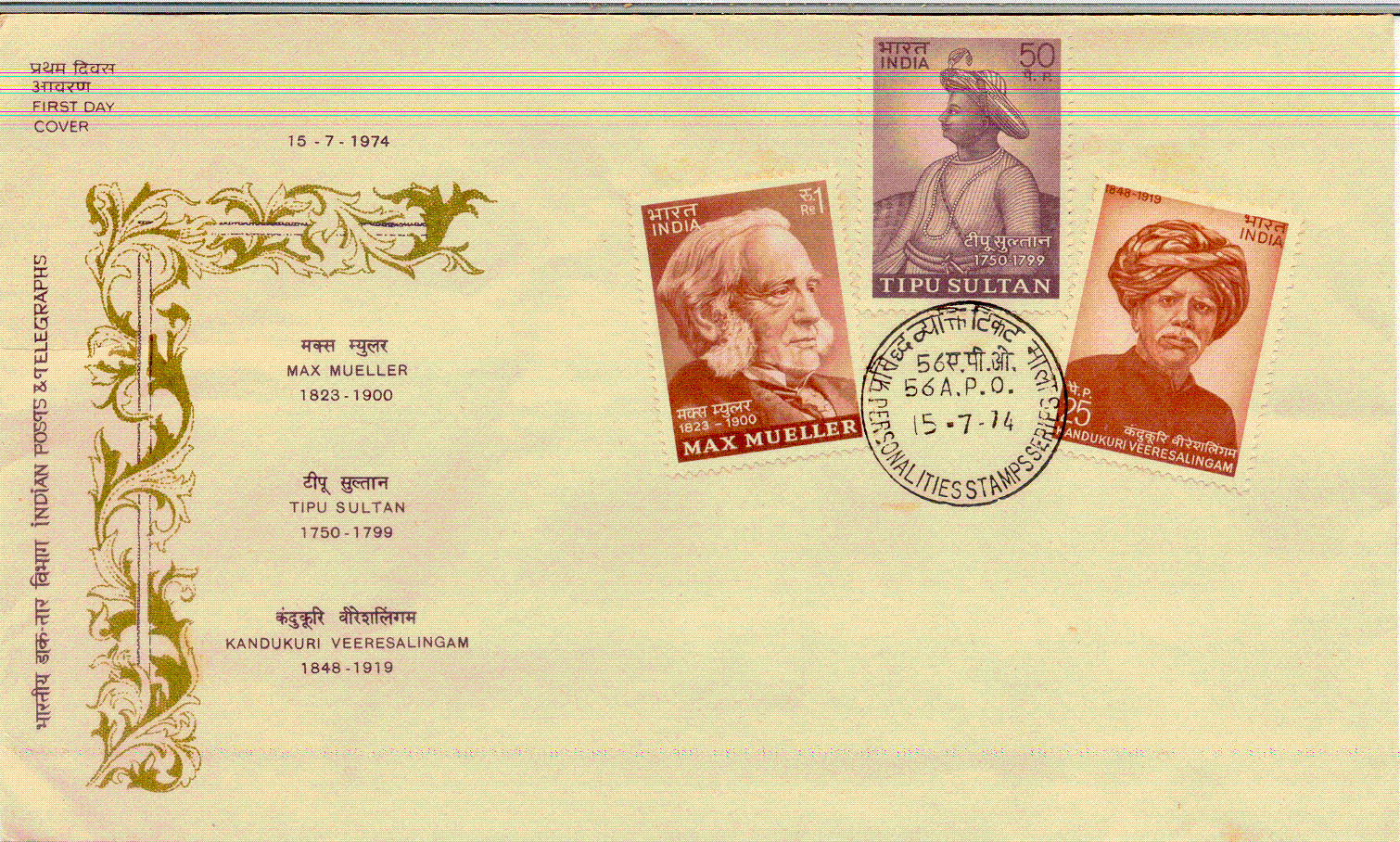
(Re1.00) Friedrich Max Müller (6 December 1823 – 28 October 1900), generally known as Max Müller, was a German-born philologist and Orientalist, who lived and studied in Britain for most of his life. He was one of the founders of the western academic field of Indian studies and the discipline of comparative religion. Müller wrote both scholarly and popular works on the subject of Indology and the Sacred Books of the East, a 50-volume set of English translations, was prepared under his direction. He also put forward and promoted the idea of a Turanian family of languages and Turanian people.
(50P) Tipu Sultan (20 November 1750 – 4 May 1799), also known as the Tiger of Mysore and Tipu Sahib, was a ruler of the Kingdom of Mysore and a scholar, soldier, and poet. He was the eldest son of Sultan Hyder Ali of Mysore. Tipu introduced a number of administrative innovations during his rule, including his coinage, a new Mauludi lunisolar calendar, and a new land revenue system which initiated the growth of Mysore silk industry. Tipu expanded the iron-cased Mysorean rockets and wrote the military manual Fathul Mujahidin, considered a pioneer in the use of rocket artillery. He deployed the rockets against advances of British forces and their allies in their 1792 and 1799 Siege of Srirangapatna.
Napoleon, the French commander-in-chief who later became emperor, sought an alliance with Tipu. In alliance with the French in their struggle with the British, and in Mysore's struggles with other surrounding powers, both Tipu and his father used their French trained army against the Marathas, Sira, and rulers of Malabar, Kodagu, Bednore, Carnatic, and Travancore. During Tipu's childhood, his father rose to take power in Mysore, and upon his father's death in 1782, Tipu succeeded to a large kingdom bordered by the Krishna River in the north, the Eastern Ghats in the east, and the Arabian Sea in the west. He won important victories against the British in the Second Anglo-Mysore War, and negotiated the 1784 Treaty of Mangalore with them after his father Hyder Ali suddenly died from cancer in December 1782 during the Second Anglo-Mysore War.
Tipu engaged in expansionist attacks against his neighbours. He remained an implacable enemy of the British East India Company, bringing them into renewed conflict with his attack on British-allied Travancore in 1789. In the Third Anglo-Mysore War, Tipu was forced into a humiliating treaty, losing a number of previously conquered territories, including Malabar and Mangalore. He sent embassies to foreign states, including the Ottoman Turkey, Afghanistan, and France, in an attempt to rally opposition to the British. In the Fourth Anglo-Mysore War, the combined forces of the British East India Company and the Nizam of Hyderabad defeated Tipu, and he was killed on 4 May 1799 while defending his fort of Srirangapatna. The Karnataka Government has been lately trying to portray Tipu Sultan as a State Hero. He is regarded a hero in Pakistan as well, and the PNS Tippu Sultan ships of the Pakistan Navy are named after him. But outside the old region of Mysore, in some South Indian regions such as Kodagu, Malabar, and Dakshina Kannada, Tipu has been accused of religious bigotry.
(25P) Rao Bahadur Kandukuri Veeresalingam also spelled as Kandukuri Veereshalingam (16 April 1848 – 27 May 1919), also known as Kandukuri Veereshalingam Pantulu, was a social reformer of Andhra Pradesh. He is widely considered as the man who first brought about a renaissance in people and Telugu literature. . He was influenced by the ideals of Brahmo Samaj particularly those of Keshub Chunder Sen. He got involved in the cause of social reforms. In 1876 he started a Telugu journal and wrote the first prose for women. He encouraged education for women, and started a school in Dowlaiswaram in 1874. He started a social organisation called Hitakarini Samajam (Benefactor).
He had many firsts to his credit: novelist (Rajasekhara Charitra inspired by Oliver Goldsmith’s The Vicar of the Wakefiled), critic, autobiographer, biographer, essayist, poet, writer of plays and playlets, satirist, investigative journalist (One judge dispensing judgments and dismissing justice committed suicide after the expose), scientific writing. He translated many books from Sanskrit and English into Telugu. He also contributed to children’s literature by basing his children’s book on Aesop’s Fables. He was all for vernacular Telugu, which became the precursor of the language now.
28 February 2015
Personalities 1974
Brief details of the three personalitis depicted on the stamps (all valued at 25P) are given below:
Jai Narayan Vyas (1899–1963) was a chief minister of the Indian state of Rajasthan. He hailed from Jodhpur city and was a leader of Indian National Congress party.
Maithilisharan Gupt (3 August 1886 – 12 December 1964) was one of the most important modern Hindi poets. He is considered one among the pioneers of Khari Boli (plain dialect) poetry and wrote in Khari Boli dialect, at a time when most Hindi poets favoured the use of Braj Bhasha dialect.
Utkal Gourab Madhusudan Das (28 April 1848 – 4 February 1934) was born on 28 April 1848 in a village called Satyabhamapur, 20 kilometres from Cuttack, Odisha. He was known as Utkal Gourab which meansPride of Utkal and was referred to as a poet and freedom fighter. He was the first graduate and advocate of Odisha.
23 February 2015
Personalities 1973
The details of this series of Personalities depicted on the three stamps on the FDC are given below :
(50P) Vithalbhai Patel was born on September 27, 1873 in Karmasad in Gujarat. After early education at Karmasad and Nadiad, Vithalbhai went to Bombay and qualified for district pleadership. In a few years he became a well known lawyer with considerable practice. His younger brother, Vallabhbhai followed his footsteps. After his return from England in 1908, as a barrister, Vithalbhai practiced in Bombay. Two years later after he lost his wife, he devoted himself entirely to public affairs. He was President of the Bombay Corporation and later he was elected to the Bombay Legislative Council as a representative of local self-governing bodies.
(30P) Ranjitsinhji (10 September 1872 – 2 April 1933), often known as Ranji, was the ruler of the Indian princely state of Nawanagar from 1907 to 1933, as Maharaja Jam Sahib, and a noted Test cricketer who played for the English cricket team. He also played first-class cricket for Cambridge University, and county cricket for Sussex. Ranji is widely regarded as one of the greatest batsmen of all time. Neville Cardus described him as "the Midsummer night's dream of cricket". Unorthodox in technique and with fast reactions, he brought a new style to batting and revolutionised the game. Previously, batsmen had generally pushed forward; Ranji took advantage of the improving quality of pitches in his era and played more on the back foot, both in defence and attack. He is particularly associated with one shot, the leg glance, which he invented or popularised. The first-class cricket tournament in India, the Ranji Trophy, was named in his honour and inaugurated in 1935 by the Maharaja Bhupinder Singh of Patiala. His nephew Duleepsinhji followed Ranji's path as a batsman playing first-class cricket in England and for the England cricket team.
Away from cricket, Ranji became Maharaja Jam Sahib of Nawanagar in 1907. He was later Chancellor of the Indian Chamber of Princes, and represented India at the League of Nations. His official title was Colonel H. H. Shri Sir Ranjitsinhji Vibhaji, Jam Sahib of Nawanagar, GCSI, GBE.
The main cricket championship in India is named after him, namely the Ranji Trophy.
(20P) Romesh Chunder Dutt, CIE was an Indian civil servant, economic historian, writer, and translator of Ramayana and Mahabharata. He was active in moderate nationalist politics and was an active Congressman in that party's initial phase. He was president of the Indian National Congress in 1899.
22 February 2015
Famous Personalities 1973
Michael Madhusudan Dutt, or Michael Madhusudan Dutta (25 January 1824 – 29 June 1873) was a popular 19th-century Bengali poet and dramatist. He was born in Sagordari, on the bank of Kopotaksho, a village in Keshabpur Upazila, Jessore District, Bengal Presidency, East Bengal (now in Bangladesh). His father was Rajnarayan Dutt, an eminent lawyer, and his mother was Jahnabi Devi. He was a pioneer of Bengali drama. His famous work Meghnad Bodh Kavya, is a tragic epic. It consists of nine cantos and is exceptional in Bengali literature both in terms of style and content. He also wrote poems about the sorrows and afflictions of love as spoken by women.
Pandit Vishnu Digambar Paluskar (August 18, 1872 – August 21, 1931) was a Hindustani musician. He sang the original version of the bhajan Raghupati Raghava Raja Ram, and founded the Gandharva Mahavidyalaya in 1901. His original surname was Gadgil, but as they hailed from the village Palus (near Sangli), they came to be known as the "Paluskar" family.
Centenary of the Discovery of Leprosy Bacillus. Gerhard Henrik Armauer Hansen (29 July 1841 – 12 February 1912) was a Norwegian physician, remembered for his identification of the bacterium Mycobacterium leprae in 1873 as the causative agent of leprosy.
Hansen was born in Bergen and studied medicine at the Royal Frederik's University (now the University of Oslo), gaining his degree in 1866. He served a brief internship at the National Hospital in Christiania (Oslo) and as a doctor in Lofoten. In 1868 Hansen returned to Bergen to study leprosy while working with Daniel Cornelius Danielssen, a noted expert.
Leprosy was regarded as largely hereditary or otherwise miasmic in origin. Hansen concluded on the basis of epidemiological studies that leprosy was a specific disease with a specific cause. In 1870–71 Hansen travelled to Bonn and Vienna to gain the training necessary for him to prove his hypothesis. In 1873, he announced the discovery ofMycobacterium leprae in the tissues of all sufferers, although he did not identify them as bacteria, and received little support. The discovery was done with a "new and better" microscope.
Nicolaus Copernicus (19
February 1473 – 24 May 1543) was a Renaissance mathematician
and astronomer who formulated a model of the
universe that
placed the
Sun rather than the Earth at its center. The publication of this model in his
book De
revolutionibus orbium coelestium (On the Revolutions of the
Celestial Spheres) just before his death in 1543 is considered a major
event in the history
of science, triggering the Copernican Revolution and
making an important contribution to the Scientific Revolution.
Copernicus was
born and died in Royal
Prussia, a region that had been a part of the Kingdom of Poland since
1466. He was a polyglot and polymath,
obtaining a doctorate in canon law and
also practising as a physician, classics
scholar, translator, governor,
diplomat and economist.
In 1517, he derived aquantity theory of money – a key concept in
economics – and, in 1519, formulated a version of what later became known
as Gresham's
law.
14 February 2015
Personalities Issue 1972
Bhai Vir Singh was born on December 5, 1872 at
Amritsar. His ancestors ere men of eminence who distinguished themselves in
social service and literary field. Nhai Vir Singh was a great poet, a scholar
and a saint. He served humanity in more than one way- as a great writer, an
educationist, a reformer and a pragmatic organiser.
In the days when the entire nation was in a political
upheaval, the freedom movement of Andhra found a great champion in T. Prakasam who was a rare combination
of great lawyer, journalist, nationalist and a politician. It is no wonder that
his lifelong exertion in such diverse fields in the srvice of nation has earned
him the honour of Andhra Kesari conferred on him by the people of Andhra
Pradesh.
A poet of the people, a philosopher of equality and a
fighting saint, Vemana was unique in
many ways. His teachings have much contemporary relevance for he was a dreamer
of one world and also advocated the concept of the universal brotherhood of
man.
As a dreamer of world peace, Bertrand Russel could say "I see in my mind's eye a great wave of
happiness seeping over the human race, as the old night of hate and fear become
dispersed. I see a new Golden Age the like of which has never been seen since
history began. All this is possible. It needs only that man should choose to
live rather than to die." The philosopher and mathematician, Bertrand
Russel, was born on May 18, 1872.
Subscribe to:
Posts (Atom)