Showing posts with label Music. Show all posts

04 November 2016

TN Tajarathinam Pillai, Thanjavur Balasaraswathi and Veenai Dhanammal 3.12.2010

The musicians portrayed on the tree stamps on the FDC are TN Tajarathinam Pillai, Thanjavur Balasaraswathi and Veenai Dhanammal.
Thiruvaduthurai Thirumarugal Natesapillai Rajarathinam Pillai (27 August 1898 – 12 December 1956) was a Carnatic musician in South India, a Nadaswaram maestro and a vocalist. He was known as TNR.  
Tanjore Balasaraswati, also known as Balasaraswati (13 May 1918 – 9 February 1984), was a celebrated Indian dancer, and her rendering of Bharatanatyam, a classical dance style originated in the South Indian state of Tamil Nadu, made this style of dancing well known in different parts of India and many parts of the world.
She was awarded the Padma Bhushan in 1957 and the Padma Vibhushan in 1977, the third and the second highest civilian honours given by the Government of India. In 1981 she was awarded the Sangeetha Kalasikhamani award of The Indian Fine Arts Society, Chennai.
Veenai Dhanammal (1867–1938) was a highly accomplished Carnatic musician, and the torchbearer of the school of Carnatic music that goes by her name. She was both a vocalist and a performer on the Saraswati veena. The prefix "Veenai" in her name is an indicator of her exceptional mastery of that instrument.

09 August 2016

Bismillah Khan 21.8.2008

Bismillah Khan (21 March 1916 – 21 August 2006), often referred to by the honorific title Ustad, was an Indian musician credited with popularizing the shehnai, a subcontinental wind instrument of the oboe class. While the shehnai had long held importance as a folk instrument played primarily during traditional ceremonies, Khan is credited with elevating its status and bringing it to the concert stage.
He was awarded India's highest civilian honour, the Bharat Ratna, in 2001, becoming the third classical musician after M. S. Subbulakshmi and Ravi Shankar to be accorded this distinction.

13 May 2016

V. Lakshminarayana 14.4.2001

V. Lakshminarayana (1911 – 1990) was the Professor of Music from Kerala, India. He was born in Kerala in 1911 and became professor of music at the age of 29. His sons L. Vaidyanathan, L. Subramaniam and L. Shankar are also a notable musicians.
He performed the violin in many World Music Festivals of Cal-State University, Whitter College Music Academy of Los Angeles. He was honoured with many awards and titles including the `Sangeetha Chakravarthy’ conferred by the Indian Music Circle USA. Prof. Lakshminarayana Iyer served as a Visiting Professor and artiste in Universities abroad. He was a Visiting Professor in California Institute of the Arts Valencia, California. He composed many kirtanas and also cittasvaras to the compositions of his composer daughter Ganam. In 1992, the Madras Music Academy, honoured V. Lakshminarayana Iyer’s contribution by placing his portrait in the “Hall of fame”. The Lakshminarayana Global Music Awards have been instituted as a tribute to his memory. He died in 1990.

28 April 2016

Ghantasala Venkateswara Rao 11.2.2003

Ghantasala Venkateswara Rao (4 December 1922 – 11 February 1974) was a legendary Indian playback singer and music composer of Telugu films and many other languages such as Tamil, Kannada, Malayalam, Tulu and Hindi. He was a recipient of the Padmashree award, India's fourth highest civilian award.
He composed music for more than 100 movies in Telugu, Tamil and Kannada films. He composed and sang the Bhagavad Gita just before his death in 1974. On 11 February 2003, a stamp was released by the Govt. of India in honor of Ghantasala at Telugu Lalita Kala Toranam, Public Gardens, Hyderabad. The US Postal Department has released a postal stamp on Ghantasala on 6 October 2014. The postal stamp was jointly released by the North American Telugu Society (NATS) in collaboration with Telugu Literary and Cultural Association (TLCA) in New York.
He is referred to as the "Gaana Gandharva" for his mesmerising voice and musical skills.

21 February 2016

Pandit Omkarnath Thakur

Omkarnath Thakur (24 June 1897 – 29 December 1967), his name often preceded by the title Pandit, was an influential Indian educator, musicologist, and Hindustani classical singer. He is famously known as "Pranav Rang", his pen-name. A disciple of classical singer Vishnu Digambar Paluskar of Gwalior gharana, he became the principal of Gandharva Mahavidyalaya, Lahore, and later went on become the first dean of the music faculty at Banaras Hindu University.

05 February 2016

Chembai Vaidyanatha Bhagavatar a.k.a. Vaidyanatha Iyer 28.8.1996

Chembai Vaidyanatha Bhagavatar a.k.a. Vaidyanatha Iyer (1 September 1896 - 16 October 1974), was a Carnatic music singer from Palakkad (state of Kerala, India). Known by his village name Chembai, or simply as Bhagavatar, he was born to Anantha Bhagavatar and Parvati Ammal in 1896, at Kottayi-I/II near Palakkad on Janmashtami day. Chembai was noted for his powerful voice and majestic style of singing. His first public performance was in 1904, when he was nine. A recipient of several titles and honours, he was known for his encouragement of upcoming musicians and ability to spot new talent. He was responsible for popularising compositions like Rakshamam and Pavana Guru, among others.

The music critic 'Aeolus' described him as "the musician who has meant the most to Carnatic Music in the first fifty years of the 20th century." His prominent disciples include Chembai Narayana Bhagavathar, Mangu Thampuran, Guruvayur Ponnammal, T. V. Gopalakrishnan, V. V. Subramaniam, P. Leela, Jayan and Vijayan, K. J. Yesudas and Babu Parameswaran, among others. He also mentored and lot of young accompanists, including Palghat Mani Iyer, Lalgudi Jayaraman, M. S. Gopalakrishnan, T. N. Krishnan, Palani Subramaniam Pillai and L. Subramaniam. Memorial music festivals have been held in his honour annually since his death in 1974, the most important being the annually celebrated Chembai Sangeetholsavam.

24 December 2015

Deenanath Mangeshkar 29.12.1993

Deenanath Mangeshkar (29 December 1900 – 24 April 1942) was a well-known Marathi theatre actor, a renowned Natya Sangeet musician and a Hindustani classical vocalist.

He is also the father of well-known singers Lata Mangeshkar, Asha Bhosle, and Usha Mangeshkar as well as composers Hridayanath Mangeshkar and Meena Khadilkar.

19 December 2015

Dwaram Venkataswamy Naidu - Birth Centenary 8.11.1993

Dwaram Venkataswamy Naidu (8 November 1893 - 25 November 1964) was one of the most important carnatic music violinists of the 20th century. Naidu was partially blind. He played at the National Physical Laboratory auditorium, New Delhi in 1952, to raise funds for the Blind Relief Association.

Yehudi Menuhin, a world-renowned violinist, was greatly impressed when he heard Dwaram play at Justice P. V. Rajamannar's house. The famous playback singer Ghantasala Venkateswara Rao learned Carnatic music under Naidu. Kalaimamani SMT.Radhanarayanan was also a disciple of V.naidu. Jayam Venkateshwaran, vocalist is a student of Radhanarayanan.

18 November 2015

Ariyakudi Ramanuja Iyengar 15.5.1991

Ariyakudi Ramanuja Iyengar (1890–1967), popularly known as Ariyakudi, was a Carnatic Music vocalist, born in Ariyakudi a town in the Karaikudi district, present Sivaganga district of Tamil Nadu. Ariyakudi developed unique style of singing came to be known as The Ariyakudi Tradition and is followed by his students. He established the modern katcheri (concert) traditions in Carnatic music.

11 August 2015

In the history of Hindustani music, there is no name so fascinating, and so haloed by the story of countless legends as Tansen's. Born in the early seventeeenth century to a brahmin poet, Makerand Pande and his wife with the blessings of a sufi fakir, Muhammed Ghaus, the child was known by various names, both hindu and muslim. It was Maharaja Ramniranjan of Gwalior who conferred on him the name of Miyan Tansen, a name, by which he is best known.

Tansen had his musical education from the great ascetic scholar, musician and composer, Swami Haridas of Brindaban. Soon after he became an accomplished musician, Tansen was made the Court-musician, by the Rewa-ruler, Ramsinghi. Before long, Tansen's fame spread far and wide and Emperor Akbar himself called him to his Court and made him one of the 'Nine Jewels' of the Imperial Court. The art of Hindustani music reached its highest watermark in Tansen's time.

02 August 2015

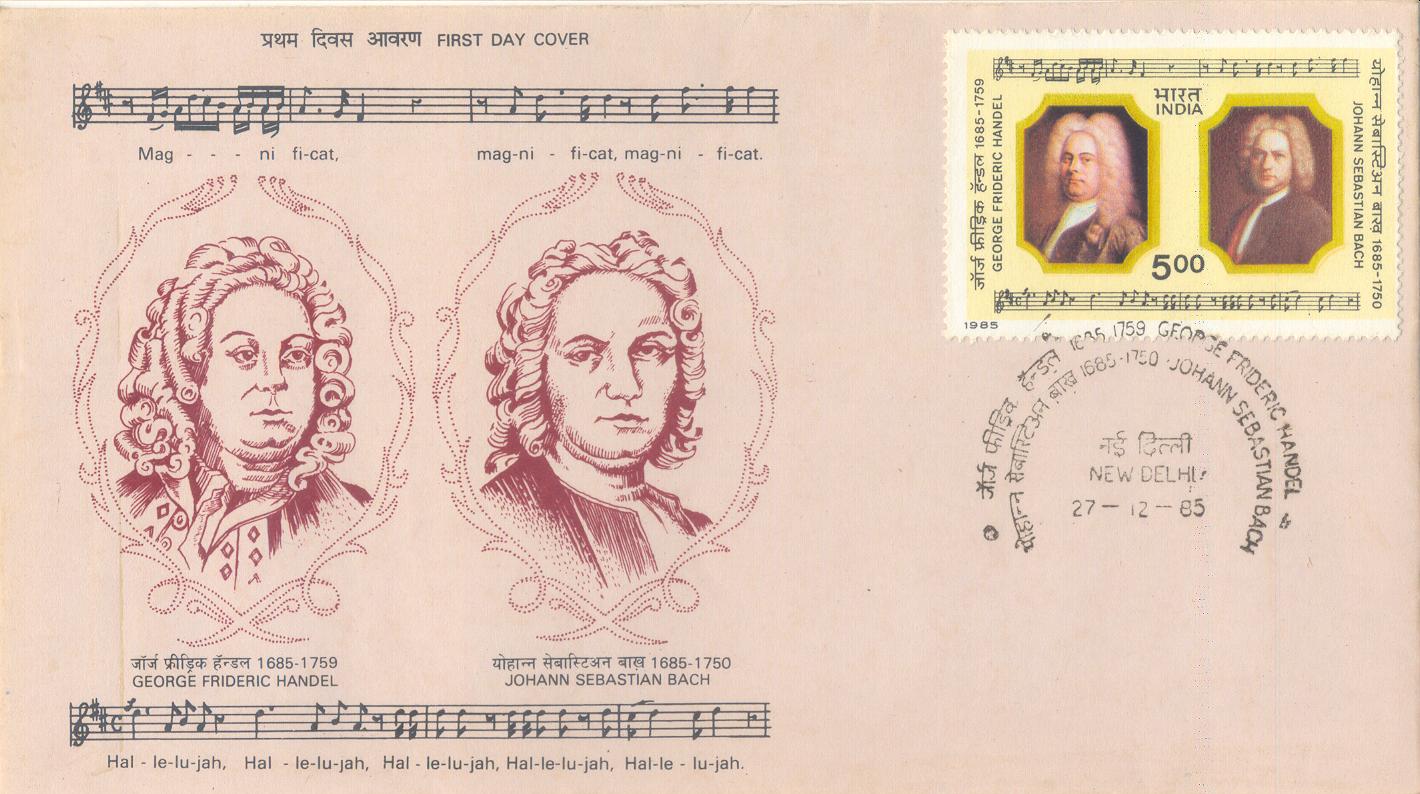
Bach and Handel 27.12.1985


In spite of fierce wars which devastated Germany, during which all other arts suffered terribly, music actually advanced in its development of truly human expression. The wealth of folk-song and church music, including the Passion, then acquired by Germany, is still one of its greatest treasures; and polyphonic art, which had so sadly declined in Italy, found a new opportunity for development and growth at the hands of the great German organists.

The time was now ripe for the arrival of two great musical geniuses, not only the greatest in Germany but in the world of that day, Bach and Handel.

George Frideric (or Frederick) Handel (born Georg Friedrich Händel 23 February 1685 – 14 April 1759) was a German-born, British Baroque composer who spent the bulk of his career in London, becoming well known for his operas, oratorios, anthems, and organ concertos. Born in a family indifferent to music, Handel received critical training in Halle, Hamburg and Italy before settling in London (1712), and became a naturalized British subject in 1727. He was strongly influenced both by the great composers of the Italian Baroque and the middle-German polyphonic choral tradition.

Johann Sebastian Bach (31 March 1685 – 28 July 1750) was a German composer and musician of the Baroque period. He enriched established German styles through his skill in counterpoint, harmonic and motivic organisation, and the adaptation of rhythms, forms, and textures from abroad, particularly from Italy and France. Bach's compositions include the Brandenburg Concertos, the Goldberg Variations, the Mass in B minor, two Passions, and over three hundred cantatas of which nearly two hundred survive. His music is revered for its technical command, artistic beauty, and intellectual depth.

31 July 2015

Shyama Sastri 21.12.1985

Shyama Sastri (1762–1827) is one of the most renowned composers of Carnatic music. He is the oldest among the Trinity of Carnatic music, Tyagaraja and Muthuswami Dikshitar being the other two.

27 July 2015

Swami Haridas 19.9.1985


Swami Haridas was a spiritual poet and classical musician. Credited with a large body of devotional compositions, especially in the Dhrupad style, he is also the founder of the Haridasi school of mysticism, still found today in North India. His work influenced both the classical music and the Bhakti movements of North India, especially those devoted to Krishna's consort Radha. Hit Harivansh Mahaprabhu, Hariram Vyas, Rupa Goswami, Sanatana Goswami, Mahaprabhu Vallabhacharya, Vitthalnath (Gusainji), and Chaitanya Mahaprabhu were his contemporaries.
He had many pupils, Tansen being one of them.

The multi colour stamp of 100 P denomination shows Swami Haridas with his Kopeen, Kantha and Karua against trees of Nidhivan.  The First Day Cover illustration is adopted from a miniature painting showing Emperor Akbar and Tansen with Swami Haridas.

22 May 2015

Raja Sir Satappa Ramanatha Muttaiya Annamalai Chettiar KCSI 30.9.1980

The stamp has a portrait of Rajah Annamalai Chettiar. The first day cover shows a sketch of the main buiding of the Annamalai University founded by Rajah Annamalai Chettiar.

Raja Sir Satappa Ramanatha Muttaiya Annamalai Chettiar KCSI (September 30, 1881 – June 15, 1948), also known as S. Rm. M. Annamalai Chettiar, was an Indian industrialist, banker, educationist and philanthropist, who is largely remembered for his social work and endowments in Tamil Nadu. He is the founder of Annamalai University in Chidambaram.

S. R. M. Annamalai Chettiar was given the title Diwan Bahadur by the British King for the valuable services rendered to the Crown. Later on the occasion of the King's birthday on 2 June 1923, he was conferred the honour of knighthood. In 1929, he was conferred the title of hereditary Rajah of Chettinad by the King of England. He was the first Raja of Chettinad.

The movement and the impetus that he gave to Tamil music were hailed by all. He died on 15 June 1948. Indian Posts and Telegraphs Department issued a commemorative stamp in his honor.

12 April 2015

100th Anniversary of the recorded sound - The Gramophone 20.7.1977

1977 is the 100th Anniversary of the recorded sound, an invention that has changed social structures and even life styles to the benefit of mankind. In April, 1877, Charles Cross, French poet, intellectual and inventor of a method of colour photography, had deposited with the Academic de Sciences in Paris a proposal for a machine to record and replay sound. At about the same time and quite independently, Thomas Alva Edison, while experimenting with means of transmitting signals by telegraph, discovered a method of recording and replaying intelligible words. Legend has it that the first sentence successfully recorded and replayed to the astonishment of the listeners was "Mary had a little lamb". On December 24, 1877, Edison applied for a patent which was in due course granted. It was the first patent to cover means of recording and replaying sound. In the same year, 1877, Emile Berliner successfully developed a method for manufacturing recorded discs quickly and cheaply in large quantities. Berliner has been described by many as the father of the Record Business. In May 1888 he demonstrated the working prototype of a 'disc playing' gramophone. In 1893 gramophones were first offered for sale to the public. The gramophone had arrived.  

Emile Berliner or Emil Berliner (May 20, 1851 – August 3, 1929) was a German-born American inventor. He is best known for developing the disc record gramophone (phonograph in American English). He founded the Berliner Gramophone Company in 1895, The Gramophone Company in London, England, in 1897, Deutsche Grammophon in Hanover, Germany, in 1898 and Berliner Gram-o-phone Company of Canada in Montreal in 1899 (chartered in 1904).

The stamp depicts a Berliner gramophone. The photograph is by courtesy of Polydor International, Hannover (W. Germany).

24 March 2015

Muthuswami Dikshitar 18.3.1976

Muthuswami Dikshitar (March 24, 1775 – October 21, 1835) was a South Indian poet and composer and is one of the Musical Trinity of Carnatic music. His compositions, of which around 500 are commonly known, are noted for their contemplative nature and for capturing the essence of the raga forms through the vainika (veena) style that emphasises gamakas. They are typically in a slower speed (chowka kala). He is also known by his signature name of Guruguha which is also his mudra (can be found in every one of his songs). His compositions are widely sung and played in classical concerts of Carnatic music.

The musical trinity consists of Dikshitar, Tyagaraja (1767–1847), and Syama Sastri (1762–1827) although, unlike the Telugu compositions of the others, his compositions are predominantly in Sanskrit. He also had composed some of his Kritis in Manipravalam.

30 January 2015

Ludwig van Beethoven - Birth Bi-Centenary

Ludwig van Beethoven (baptised 17 December 1770 – 26 March 1827) was a German composer and pianist. A crucial figure in the transition between the Classical and Romantic eras in Western art music, he remains one of the most famous and influential of all composers. His best-known compositions include 9 symphonies, 5 concertos for piano, 32 piano sonatas, and 16 string quartets. He also composed other chamber music, choral works (including the celebrated Missa solemnis), and songs.

Born in Bonn, then the capital of the Electorate of Cologne and part of the Holy Roman Empire, Beethoven displayed his musical talents at an early age and was taught by his father Johann van Beethoven and byChristian Gottlob Neefe. During his first 22 years in Bonn, Beethoven intended to study with Wolfgang Amadeus Mozart and befriended Joseph Haydn. Beethoven moved to Vienna in 1792 and began studying with Haydn, quickly gaining a reputation as a virtuoso pianist. He lived in Vienna until his death. In about 1800 his hearing began to deteriorate, and by the last decade of his life he was almost totally deaf. He gave up conducting and performing in public but continued to compose; many of his most admired works come from this period.

27 September 2014

Vishnu Narayan Bhatkhande - Birth Centenary 1.9.1961

Pandit Vishnu Narayan Bhatkhande (August 10, 1860 – September 19, 1936) was an Indian musicologist who wrote the first modern treatise on Hindustani Classical Music (The north Indian variety of Indian classical music), an art which had been propagated earlier for a few centuries mostly through oral traditions. During those earlier times, the art had undergone several changes, rendering the raga grammar documented in scant old texts outdated.
Ragas used to be classified into Raga (male), Ragini (female), and Putra (children). Bhatkhande reclassified them into the currently used Thaat system. He noted that several ragas did not conform to their description in ancient Sanskrit texts. He explained the ragas in an easy-to-understand language and composed several bandishes which explained the grammar of the ragas. He borrowed the idea of lakshan geet from the Carnatic music scholar Venkatamakhin.
Bhatkhande wrote all of his works under one of the two pseudonyms - Vishnu Sharma and Chaturpandit.
Bhatkhande started schools and colleges in India for systematic teaching of Hindustani music. In 1916, he reorganized the Baroda state music school, and later, with the help of theMaharaja of Gwalior, established the Madhav Music College in Gwalior.
Bhatkhande prepared the Hindustani Sangeet Karmik Pustak Malika as a series of textbooks. He also started the tradition of the All India Music Conferences to provide a common platform for discussion between Hindustani and Carnatic classical musicians.

20 September 2014

Tyagaraja Aradhana Day 6.1.1961

Tyagaraja Aradhana is an annual Carnatic music festival held in January and February. Many exponents of Carnatic music come to perform and are watched by thousands of ardent fans of Indian classical music. It is associated with the world famous singer and saint Tyagaraja and is one of the most important music festivals in India.

Kakarla Tyagabrahmam (4 May 1767 – 6 January 1847), colloquially known as Tyāgarāju or Tyāgayya in Telugu, Tyāgarājar in Tamil, was one of the greatest composers of Carnatic music or Indian classical music. He was a prolific composer and highly influential in the development of the classical music tradition. Tyagaraja composed thousands of devotional compositions, most in praise of Lord Rama, many of which remain popular today. Of special mention are five of his compositions called the Pancharatna Kirtis (English: "five gems"), which are often sung in programs in his honour.

Tyagaraja has acknowledged the great "Purandaradasa " as his guru in his magnum opus "Prahlada Charita " .Purandara dasa served as an inspiration to him.