Showing posts with label Armed Forces. Show all posts

02 February 2017

Commemorative postage stamps on the Valour and Sacrifice of the Armed Forces of 1965 War 15.9.2015


The three Rupees 5.00 Stamps depict the spirit and resoluteness of purpose displayed by the three wings of Indian Armed Forces during the 1965 war. The Indian Armed Forces, despite being lightly equipped in all sectors, fought valiantly in the true spirit of the Indian Soldier, with resilience to adversity. The Pakistan Armed Forces were in for a rude shock when operations by Indian Armed Forces brought their offensive in both the Western and Eastern Sectors to a screeching halt. This was achieved through leadership and adroit application of operational art. The timely entry of the Air Force into the conflict provided additional impetus that eventually stalled Pakistan’s nefarious designs, especially in the Chhamb–Jaurian Sector.
Significant endeavours of the Indian Armed Forces during the 1965 War were the capture of Hajipir, blunting of the Pakistani offensive in Chhamb–Jaurian, Battle of Asal Uttar, the Ichhogil Canal operations and the advance onto Lahore. The tank battles of 1965 take their place in annals of military history as the most intense ones used since World War II. On 10th September 1965, the Indian Armed Forces stuck a massive blow to the armada of Pakistani tanks when the offensive of Pakistan’s 1st Armoured Division was blunted at the Battle of Asal Uttar, in the Khemkaran Sector.
Poised against the Pakistani Air Force which was equipped with a much more ‘modern’ inventory of fighter aircraft, the Indian Air Force (IAF) responded with alacrity to the call for air support, and succeeded in thwarting the Pakistani offensive. The IAF proved its mettle in each of the operations carried out, both in the Western as well as the Eastern Sector. The grit and valour displayed by our Air Warriors was yet another glorious chapter in the history of the IAF.
The Indian fleet was deployed to ensure defence of the Western and eastern Coasts and the island territories. Given the Government’s determination to limit the scope of the conflict as much as possible, the Indian Fleet flying the flag of Rear Admiral BA Samson on-board INS Mysore, remained vigilant and carried out intensive patrols and sweeps within India’s continental shelf. The Alize and Seahawk aircraft of the Indian Navy carried out sorties from 10 Sep – 23 Sep 1965 for maritime surveillance. By these actions Pakistan navy was forced to stay put in Karachi during this war. I was serving on board INS Kirpan (which was part of the Indian Fleet) during this war.

18 April 2016

Centenary of the Indian Ordnance Factories 18.3.2002


The patronage they receive both in India and abroad speaks of their quality of products and services. Undoubtedly, they are the force behind Indian armed forces.
Indian Ordnance Factories are the oldest and largest industrial setup which functions under the Department of Defence Production of the Ministry of Defence. The ordnance factories form an integrated base for indigenous production of defence hardware and equipment, with the primary objective of self reliance in equipping the armed forces with state of the art battlefield equipments.

14 March 2016

The Defence Services Staff College (DSSC) - Golden Jubilee 16.4.1998

The Defence Services Staff College (DSSC) is an inter-service institution of the Indian Armed Forces. It trains officers of the all three Indian Armed Forces which are the (Navy, Army, Air Force) and officers from friendly foreign countries for command and staff appointments.
One of the oldest military institutions in India, it was founded in 1905 as the Army Staff college in Deolali (near Bombay), and then re-located to Quetta (now Pakistan). After the partition of India and Pakistan, the Indian operations relocated to its present home in Wellington Cantonment in The Nilgiris District of Tamil Nadu, India.
By 1950 it was progressively transformed into a fully integrated Defence Services Staff College, imparting training to Officers of the three services in the company of some officers from the Indian Civil Services, Para Military Forces and friendly foreign countries. DSSC is affiliated to Madras University for award of M.Sc. degree in Defence and Strategic Studies and was recognized as a research institute in 1990.

I had the good fortune of graduating from this great institution in 1975 and serving on the Directing Staff for three years thereafter.

02 November 2015

Indian Peace Keeping Force (IPKF) 30.5.1990

Indian Peace Keeping Force (IPKF) was the Indian military contingent performing a peacekeeping operation in Sri Lanka between 1987 and 1990. It was formed under the mandate of the 1987 Indo-Sri Lankan Accord that aimed to end the Sri Lankan Civil War between militant Sri Lankan Tamil nationalists such as the Liberation Tigers of Tamil Eelam (LTTE) and the Sri Lankan military.
The main task of the IPKF was to disarm the different militant groups, not just the LTTE. It was to be quickly followed by the formation of an Interim Administrative Council. These were the tasks as per the terms of the Indo-Sri Lankan Accord, signed at the behest of Indian Prime Minister Rajiv Gandhi. Given the escalation of the conflict in Sri Lanka, and with the pouring of refugees into India, Gandhi took the decisive step to push this accord through. The IPKF was inducted into Sri Lanka on the request of Sri Lankan President J. R. Jayewardene under the terms of the Indo-Sri Lanka Accord.
The force was initially not expected to be involved in any significant combat by the Indian High Command. However, within a few months, the IPKF became embroiled in battle with the LTTE to enforce peace. The differences started with LTTE trying to dominate the Interim Administrative Council, and also refusing to disarm, which was a pre-condition to enforce peace in the island. Soon, these differences led to the LTTE attacking the IPKF, at which point the IPKF decided to disarm the LTTE militants, by force if required. In the two years it was in northern Sri Lanka, the IPKF launched a number of combat operations aimed at destroying the LTTE-led insurgency. Given LTTE's tactics in guerrilla warfare and using women and child soldiers to fight battles, it soon escalated into repeated skirmishes between the IPKF and LTTE.
The IPKF began withdrawing from Sri Lanka in 1989, following the election of the V. P. Singh government in India and on the request of the newly elected Sri Lankan President Ranasinghe Premadasa. The last IPKF contingents left Sri Lanka in March 1990.

Operation Pawan ("Operation Wind") was the codename assigned to the operation by the Indian Peace Keeping Force (IPKF) to take control of Jaffna from the Liberation Tigers of Tamil Eelam (LTTE), better known as the Tamil Tigers, in late 1987 to enforce the disarmament of the LTTE as a part of the Indo-Sri Lanka Accord. In brutal fighting lasting about three weeks, the IPKF took control of the Jaffna Peninsula from the LTTE, something that the Sri Lankan army had tried but prevented mainly due to Indian political interventions. Supported by Indian Army tanks, helicopter gunships and heavy artillery, the IPKF routed the LTTE, at the cost of 214 soldiers.

13 February 2015

Greetings to our Forces 1972 15.8.1972

The Indian Posts and Telegraphs department commemorated the valiant role played by the Armed Forces of India in the cause of the Motherland during the last 25 years of Independence, by bringing out a special commemorative stamp. On this occasion, the Indian P & T Department joined the rest of the country in remembering with deep gratitude the sacrifices and hardships endured by the members of Armed Forces in continuing to keep the flag of India flying high. The commemorative stamp brought out on the occasion depicts the inter Services Crest.
The stamp “Greetings to our Forces” depicts the inter Services Crest. The three strips of Army, Navy and the Air Force colours are shown in the background.

01 December 2014

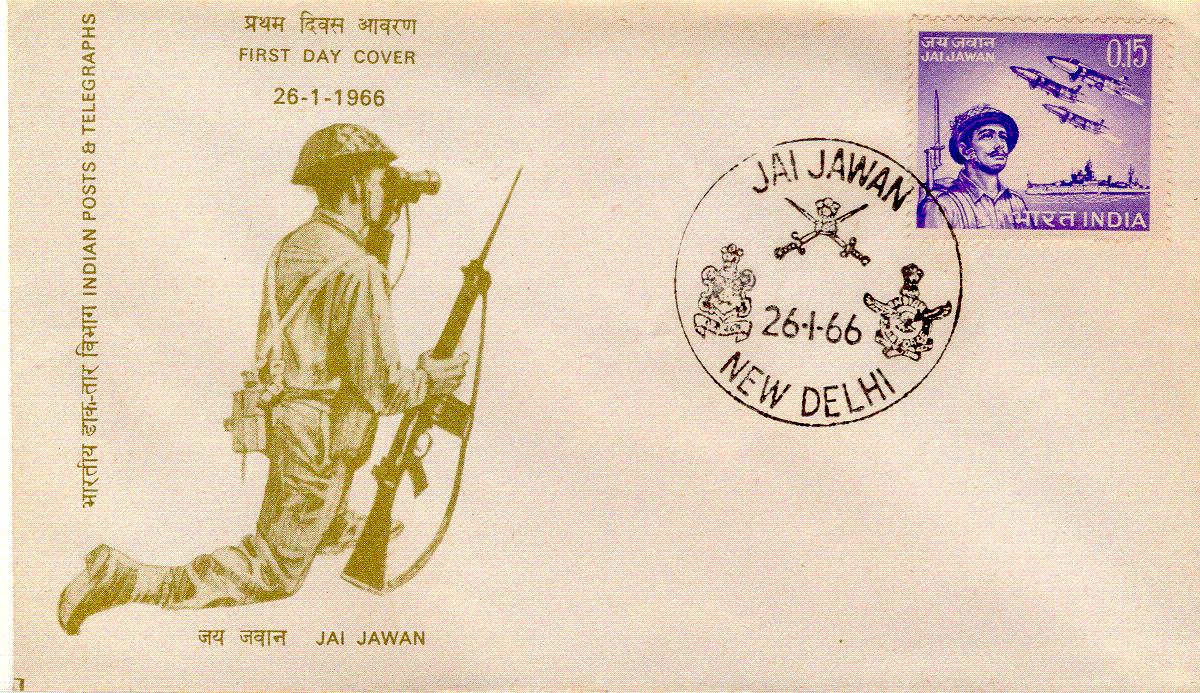
Jai Jawan - Lal Bahadur Shastri's Slogan 26.1.1966

This stamp was issued to commemorate the armed forces on the first republic day after the 1965 War.The stamp, released on 26 Jan 1966 features an army soldier in battle rig, INS Mysore the flag Ship of the Indian Navy and a formation of three Gnat aircraft.  

20 October 2014

Defence Effort 15.8.1963

In the aftermath of the very humiliating rout of the Indian Army at the hands of the Chinese in 1962, every effort was being made to raise the morale of the Armed Forces. These two stamps on the FDC’s was but one such effort in 1963. The 15nP stamp depicts an artillery pice and an Army helicopter. The Re.1 stamp depicts a sentry on duty and a para dropping of supplies.

Below is the brochure issued by the Post and Telegraph Dept. Look carefully do you see Indian Navy mentioned anywhere. Don't waste your time it isn't there. It was a gross negligence according to me.